What to Do If You Miss Your Cruise Ship — A Step-By-Step Guide
Every year, cruise passengers find themselves facing the moment they miss their cruise ship, watching it pull away from the dock without them. It happens at embarkation ports when flights run late. It happens at ports of call when shore excursions run long or travelers lose track of time. And it happens to experienced cruisers who’ve done this dozens of times.
As a retired NYPD Anti-Terrorism and Transit Special Operations officer, I’ve spent my career managing high-pressure situations where staying calm and knowing the right steps made the difference between a bad situation and a catastrophic one. Missing your cruise ship is stressful — but it is manageable if you know what to do before it happens.
This guide covers exactly that.
📋 Free Download: Missed Ship Emergency Checklist
Sign up for the Travel Safety Authority newsletter and get the free one-page emergency checklist delivered instantly to your inbox.
Get the Free Checklist →If You Miss Your Cruise Ship: Two Different Scenarios
Before getting into the steps, it’s important to understand that missing your ship at embarkation and missing your ship at a port of call are two different situations with different rules and different options.
Missing on embarkation day means the ship departed without you before your cruise officially began. You were never checked in as a passenger. This is the more serious scenario — cruise lines generally treat this as a no-show, and you are responsible for catching up to the ship at the next port entirely on your own, at your own expense. Whether you can legally board at a later port depends on your itinerary, the country, and a U.S. law called the Passenger Vessel Services Act.
Missing at a port of call means you were already onboard, went ashore, and didn’t make it back before the all-aboard time. The ship’s security team will know you’re missing because your keycard wasn’t scanned back onboard. The cruise line has a more established process for handling this situation.
A Safety Perspective: Why This Happens — and How to Think About It
From a law enforcement perspective, most missed ship situations are predictable and preventable. They fall into a few consistent patterns: travelers who flew in the same day as embarkation and hit a delay, travelers who booked independent excursions without accounting for transit time, and travelers who confused ship time with local time.
Ship time and local time are not always the same — and the difference can catch experienced cruisers off guard. Royal Caribbean displays ship time directly in their app, which is the most reliable way to confirm it on those itineraries. Other cruise lines may handle this differently, so don’t assume your phone’s automatic time zone setting matches the ship’s clock. The cruise director’s daily announcements and the printed schedule are your most reliable source — if there’s ever a question, confirm directly with Guest Services before going ashore.
Insider Tip: Before you go ashore at any port, photograph your daily Cruise Compass or planner. On a typical port day, this document includes the all-aboard time, the port agent’s direct phone number and email, the local U.S. Embassy or Consulate contact information, and local law enforcement contact details for that specific port. Having all of that saved on your phone means you’re never searching for a number while standing on a dock trying to figure out what to do next.
Step-By-Step: What to Do If You Miss Your Ship
Step 1 — Stay Calm and Assess
The worst thing you can do when you miss your cruise ship is panic. I’ve worked high-pressure situations for years and the principle is the same everywhere: panic burns time and clouds judgment. Take a breath. You are safe. This is a logistics problem, not a life-threatening emergency. Focus on the next step, not the worst-case scenario.
Step 2 — Go to the Port Agent Immediately
Whether you miss your cruise ship at embarkation or at a port of call, the port agent is your first and most important contact. Every cruise port has a port agent — a certified liaison between the cruise ships and the shore. Most cruise lines station their own port agents at or near the pier. The port agent’s contact information is listed in your ship’s daily newsletter and in the cruise line’s app — which is exactly why you photographed it before going ashore.
The port agent can contact the ship on your behalf and assist with next steps including travel arrangements. Do not leave the port area without first checking in with the port agent.
Step 3 — Call the Cruise Line Directly
Call the cruise line’s customer service number. Do not rely on the app for this — a phone call gets you to the right person faster. Every major cruise line has a dedicated line for reaching the ship in an emergency. That number is on your daily events sheet, your shore excursion paperwork, and your cruise line’s website. This is why you saved it in your phone before going ashore.
Explain your situation, provide your booking details, and ask specifically whether rejoining the ship at the next port is possible. Do not assume it is — and do not book flights to the next port until the cruise line confirms that boarding is permitted.
Step 4 — Understand the Passenger Vessel Services Act
This is the part most passengers don’t know about until it’s too late. The Passenger Vessel Services Act (PVSA) is a U.S. federal law, codified at 46 U.S.C. § 55103 and enforced by U.S. Customs and Border Protection, that prohibits foreign-flagged vessels from transporting passengers between two U.S. ports.
In plain terms — if your itinerary sails between two U.S. ports, you may not legally be permitted to board at an intermediate U.S. port if you missed embarkation.
Carnival Cruise Line states this explicitly on their own website: guests who miss the ship at the homeport are not allowed to embark at any port of call if doing so would violate the PVSA.
This most commonly affects Alaska itineraries and closed-loop Caribbean itineraries with U.S. stops like Key West. The cruise line will advise you on whether this applies to your specific itinerary. Always confirm before booking any travel to catch up.
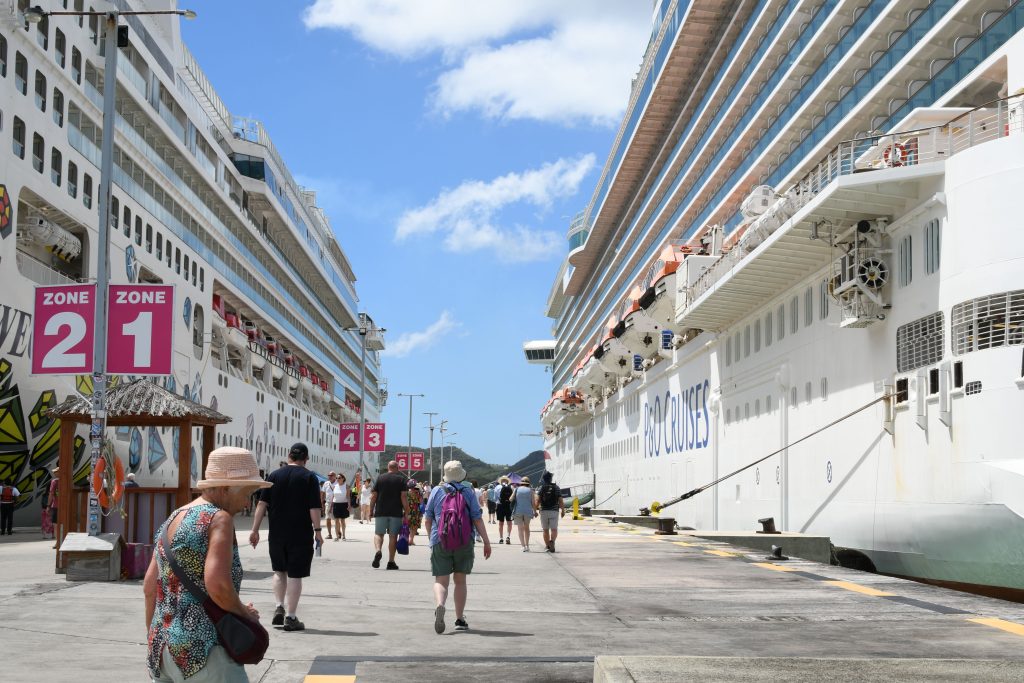
Step 5 — Secure Your Passport
The U.S. State Department’s official cruise travel guidance is clear: always carry your passport with you ashore in case of an emergency, including the possibility of an unexpected medical evacuation or needing to make your own way home.
If you left your passport on the ship and the ship has departed without you, contact the port agent immediately — they may be able to coordinate with the cruise line on your behalf. If your passport cannot be recovered, contact the nearest U.S. Embassy or Consulate. The State Department confirms that if there isn’t enough time to issue a regular passport, the consular section can issue an emergency limited-validity passport valid for up to one year, which allows you to fly home. Most U.S. embassies and consulates have after-hours duty officers available for life-or-death emergencies.
U.S. Embassy and Consulate emergency line from outside the U.S.: +1-202-501-4444
This is why the State Department — and I — recommend carrying your passport on your person every time you go ashore at a foreign port. The one exception is a cruise line’s private island, where you remain on the cruise line’s own property all day and a passport typically isn’t necessary. A waterproof phone and document holder keeps your passport, cash, cards, and phone protected and on your person at all times when you do need it.
Step 6 — Secure Yourself Financially
You will need a working credit card. If your wallet and cards are on the ship, contact your bank immediately — most major banks have 24/7 international lines and can arrange emergency funds or card access.
Don’t assume a mobile wallet on your phone will solve this — not every merchant in every port accepts mobile payments, and if your phone was also on the ship, that option is gone entirely. This is why carrying your physical cards ashore in an RFID blocking money belt is standard practice.
Step 7 — Arrange Accommodations and Transportation
If you’re catching up to the ship at the next port — and the cruise line has confirmed this is permitted — book your travel immediately. Flights, hotels, and ground transportation at short notice in a foreign port city will not be cheap. Document every expense with receipts. You will need this documentation for any insurance claim.
If catching up is not possible or practical, book travel home. Your belongings on the ship will remain in your cabin — contact the cruise line for the process to have them returned.
Step 8 — Contact Your Travel Insurance Provider
Call your travel insurance provider’s 24-hour assistance line as soon as you’ve stabilized the immediate situation. Comprehensive travel insurance plans including RoamRight travel insurance cover missed ship scenarios through trip interruption, missed connection, and travel delay benefits — which can reimburse you for hotel stays, meals, and transportation costs to rejoin the cruise or return home.
Important: coverage applies to covered reasons as defined in your specific policy. Losing track of time on an independent excursion may not be a covered reason. Review your policy carefully before travel, and contact your provider directly with coverage questions. I am not a licensed insurance agent — always verify coverage details with your provider.
The One Scenario Where the Ship Will Wait
There is one reliable exception to the rule that you’ll miss your cruise ship entirely: if you are on a shore excursion booked directly through the cruise line, the ship will wait for you or the cruise line will cover the cost of getting you to the next port. This is standard policy across major cruise lines.
This is one of the strongest arguments for booking at least some excursions through the cruise line — especially in ports where timing is tight, traffic is unpredictable, or distances are significant. Independent tours offer flexibility and often better value, but they come with full personal responsibility for your return timing.
How to Prevent Missing Your Ship
Prevention is always better than crisis management. Here’s what I recommend as standard practice so you never have to miss your cruise ship in the first place:
Before You Leave Home
Arrive at your embarkation port the day before your cruise — never fly in same-day. This single decision eliminates the most common cause of missed embarkation entirely. Save your cruise line’s emergency contact number in your phone before you even leave home — every major cruise line publishes this number on their own website under their Contact Us or FAQ section, so you don’t have to wait until you’re onboard to find it. If you’re stranded ashore at any point during your cruise, you need to be able to reach the ship without hunting for a number.

Every Port Day
Know the all-aboard time before you leave the ship — not the departure time. The all-aboard time is typically 30 to 60 minutes before sailing. That is your deadline, not the time the ship leaves the dock. Verify which time zone your phone is displaying before going ashore — in some ports, phones automatically adjust to local time, and if local time differs from ship time, you could be operating on the wrong clock without realizing it.
Carry your passport ashore on every port day — not in your cabin safe. The U.S. State Department recommends this specifically for cruise passengers. The one exception is a cruise line’s private island, such as Perfect Day at CocoCay, Ocean Cay, or Harvest Caye — since you remain on the cruise line’s controlled property the entire day, a passport typically isn’t necessary there. A waterproof document holder keeps it protected on every other port day.
Build in a buffer — if your all-aboard time is 4:00 PM, plan to be back at the ship by 3:00 PM. Traffic, vehicle breakdowns, and unexpected delays happen. A one-hour buffer is standard practice, not excessive caution.
Missing your cruise ship doesn’t have to ruin your vacation.
For more port safety best practices, read 10 Cruise Port Safety Tips From a Retired NYPD Officer. And before your next sailing, read Do You Really Need Travel Insurance for a Cruise? — missing your ship is exactly the kind of situation travel insurance is designed for.
Travel safe. Enjoy every port.
— Rick Hayes, Travel Safety Authority
Have questions about cruise safety planning or want help preparing for a specific itinerary? Visit the Work With Rick page to get started. Please note: I am not a travel agent in my capacity as the author of Travel Safety Authority, and I earn no booking commission on your sailing.
This article contains affiliate links. If you purchase, book, or make a reservation through a link on this page, I may earn a small commission at no additional cost to you. Affiliate relationships include but are not limited to Amazon Associates, Viator, RoamRight, and other travel and product partners. This does not influence my recommendations — I only link to products, services, and experiences I would genuinely recommend to my own clients. Travel insurance recommendations are provided for informational purposes only. I am not a licensed insurance agent. Please review all policy details carefully before purchasing. See my full Disclaimer for details.
The information in this article is provided for general educational purposes only and reflects the personal experience and professional background of the author. It is not a substitute for professional security consultation or official government travel guidance. Safety conditions at any destination can change rapidly — always verify current advisories at travel.state.gov before your trip. Reliance on any information in this article is at your own risk. This site may contain affiliate links; see the full Disclaimer for details.