Bringing Medication on a Cruise: Prescriptions, Medical Equipment, and the Mistake That Gets People Flagged at the Terminal
Bringing medication on a cruise starts as a small question and grows fast. Do the pill bottles go in the suitcase or the carry-on? What about the insulin that has to stay cold? The CPAP machine and its distilled water? The oxygen concentrator? And what about the CBD gummies you take for sleep — the ones that are perfectly legal at the store where you bought them?
Every one of those questions has a real answer, and most of them are buried in policy pages you’d never find until something goes wrong at the pier. I’m Rick Hayes, a cruise safety expert and retired NYPD Anti-Terrorism officer, and I also travel with a disability of my own that requires a conversation with the cruise line before every sailing. Bringing medication on a cruise is completely routine — thousands of passengers do it on every sailing. But the rules around equipment, refrigeration, and one particular category of product are specific enough that guessing is how people end up standing at a security table watching their bag get unpacked. This guide walks through all of it: prescriptions, machines, cold storage, dialysis, oxygen, and the cannabis and CBD rules that changed in 2026 and still trip up careful, well-intentioned travelers.
This article is part of our five-part accessible cruising series: Cruising with a Disability (start here) · Mobility & Physical Accessibility · Mental Health & Psychological Conditions · Service Animals

Start With the Accessibility Department, Not the Packing List
Who Can I Contact About Bringing Medication on a Cruise?
Every major cruise line has a dedicated accessibility department that handles medication and equipment needs before you sail. Call the number on your line’s accessibility or special needs page — not general reservations — well ahead of your sailing, since most lines require advance notice for medical arrangements.
Each line names this department differently and sets its own forms and deadlines — the full contact list for all four major lines is in the series overview, Cruising with a Disability. For the rest of this article, I’ll call it the accessibility department: one plain term for the same job at every company.
Here’s why the call matters for medical equipment specifically: the standard policies cover the common cases, and a lot of real medical needs don’t fit the common cases. A CPAP machine is a checkbox on a form. An oxygen concentrator plus a backup cylinder plus a medication that needs refrigeration plus a sharps container is a conversation — and the accessibility department has that conversation every single day. Norwegian asks for notice at least 45 days before sailing for most needs. That’s not bureaucracy for its own sake; it’s the lead time the ship needs to have your arrangements actually waiting for you.
What Security Is Actually Looking For — and How to Sail Through It
Can You Bring Medication on a Cruise?
Yes — you can bring prescription and over-the-counter medication on a cruise, along with CPAP machines, oxygen equipment, and insulin supplies. Keep everything in original, labeled containers, hand-carry it rather than checking it, and confirm any equipment or refrigeration needs with the cruise line’s accessibility department before sailing.
I spent my NYPD career around screening operations — the checkpoints, the X-ray belts, the bag checks that move enormous numbers of people through places like Penn Station. So let me tell you what the cruise terminal screening process is from the inside, because understanding it removes most of the anxiety.
Every bag that boards a cruise ship gets screened, the same way airport luggage does. The screeners are not hunting for your blood pressure pills. They’re looking for weapons, fire hazards, alcohol, and drugs. Medication in labeled pharmacy containers, medical devices that look like medical devices, and supplies that match a person’s declared needs pass through screening thousands of times a day without a second glance. The people who get pulled aside are almost always the ones whose bags contain something that doesn’t match the rules — and the most common medical-adjacent example, by a wide margin, is cannabis and CBD products. We’ll get to that in detail below, because it deserves its own section.

Two Habits That Keep You Out of Trouble
Two simple habits handle almost every problem before it starts:
- Hand-carry everything medical. Carnival’s own guidance tells guests to hand-carry CPAP machines, concentrators, and similar equipment rather than placing them in checked luggage, and to label all equipment with your name, contact details, and cabin number. Norwegian says the same about medications: original containers, in your hand luggage. This isn’t just policy — checked cruise luggage can take hours to reach your cabin on embarkation day, and your evening medications shouldn’t be sitting in a bag somewhere on deck two.
- Keep medications in their original pharmacy containers, with a copy of the prescription. Norwegian’s guidance is explicit that narcotics must be accompanied by a valid prescription. A photo of each prescription on your phone, plus a one-page letter from your doctor listing your medications and devices, costs you ten minutes before the trip and answers essentially any question anyone at any checkpoint — ship or foreign port — could ask.
Why You Need Extra Days of Medication
One more piece of preparation that belongs here because it’s genuinely a safety issue: the ship’s medical center is for emergencies and routine sick calls, not for supplying your ongoing treatment. Carnival’s own special requirements form states plainly that the Medical Center’s oxygen is for emergency use only, and that guests who need oxygen during the cruise must arrange their own supply. The same principle applies to medication: Norwegian tells guests to bring enough for the entire voyage plus ten extra days for unexpected delays. A missed flight, a skipped port, a weather diversion — ten extra days of medication turns any of those from a medical problem into a minor inconvenience.
Insider Tip: Photograph the label of every prescription bottle and every piece of medical equipment (including the model and serial number) before you leave home, and email the photos to yourself. If a bag is delayed, a device is damaged, or a foreign port official has questions, you can produce documentation in thirty seconds from your phone. I built the same habit on the job for a different reason — documentation you can produce instantly ends conversations that would otherwise become problems.
Prescription Medications: The Basics, Then the Borders
The onboard part is simple. Original containers, carry-on, full supply plus ten days, prescriptions documented. If you lose or run out of a medication, the ship’s physician may be able to prescribe an available alternative, but Norwegian’s guidance is honest about the limits: exact brands and dosages aren’t guaranteed. Ships carry a working pharmacy, not a Walgreens.
Crossing Borders With Controlled Substances
The border part is where people under-prepare. A cruise isn’t one country’s rules — it’s a new legal environment at every port. The overwhelming majority of prescription medications travel internationally without any issue when they’re in original containers with documentation. The category that needs real attention is controlled substances — plain English: medications the government tracks because they can be misused, like opioid painkillers, ADHD stimulants, and anti-anxiety medications such as benzodiazepines. Some countries regulate these more tightly than the United States does, and a few restrict specific medications that are routine at home.
Here’s the practical routine, and it takes one evening:
- Look up the U.S. State Department country information page for each country on your itinerary. These pages flag medication restrictions when they exist and link to each country’s embassy.
- If you take a controlled substance, check the destination country’s embassy page or contact them directly about whether your medication requires documentation beyond the prescription. For a standard Caribbean itinerary this almost always comes back fine — but “almost always” is exactly the kind of phrase you verify rather than trust.
- Carry the doctor’s letter mentioned above. For controlled substances, it’s the single most useful document you can have.
And a warning worth repeating from Norwegian’s own guidance because it’s genuinely dangerous: don’t buy prescription or over-the-counter medications from open-air markets or unverified vendors in ports. Counterfeit medications are a real problem in tourist areas, and some contain harmful substances. If you need a medication mid-cruise, the ship’s medical center is the right door to knock on — even with its limits, everything in it is real.
Insulin, Refrigeration, and Sharps
Solving the Cold-Chain Problem
If your medication needs to stay cold, plan the cold chain before you sail, because the obvious solution doesn’t work: cruise ship cabin minibars are coolers, not refrigerators, and Norwegian’s guidance says directly that they’re not suitable for storing temperature-sensitive medicine.
What does work, verified against the cruise lines’ own pages:
- A small personal cooler. Both Norwegian and Carnival permit a personal cooler up to 12″ x 12″ x 12″ as carry-on for medications. Packed with ice from room service (free on every major line), a basic soft cooler handles insulin storage for most travelers the entire cruise.
- A requested medical refrigerator. This goes through the accessibility department in advance — it’s one of the standard requests they handle, and availability is the reason the notice windows exist.
- A cooler from your medication’s manufacturer. Some pharmaceutical patient-support programs provide enrolled patients a branded travel cooler at no cost — I’ve gotten one myself from AbbVie. It’s not a guarantee, and the programs don’t advertise it as a standing benefit, so call the number on your prescription paperwork and ask directly rather than assuming it’s included.
- Medical center storage. Norwegian notes its Medical Centers may provide storage access during clinic hours. Useful as a backup, but clinic hours are limited — this shouldn’t be your primary plan for a medication you inject on a schedule.
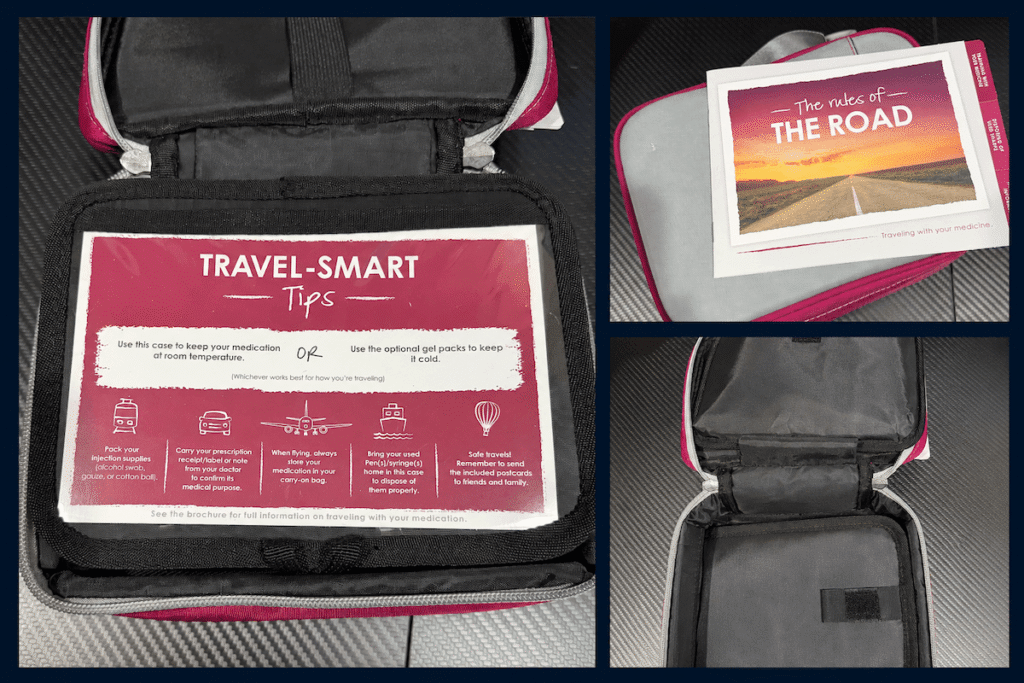
Sharps are simpler than people expect. Don’t improvise disposal — a sharps container is a standard onboard request. On Carnival and Norwegian ships, guests can obtain one through Guest Services, the room steward, or the Medical Center. Tell the accessibility department in advance that you’ll need one and it’s a non-event.
CPAP Machines, Distilled Water, and the Outlet Problem
CPAP and BiPAP machines — the bedside machines that keep your airway open while you sleep — are among the most common medical devices at sea, and every major line accommodates them. Carnival states plainly that it permits BiPAP, CPAP, concentrators, and nebulizers onboard; you bring your own equipment, hand-carried, labeled. The details that actually matter are the three things the policy pages bury:
Distilled water. Your machine’s humidifier needs it, and the answer is different by line — which is exactly the kind of thing to confirm rather than assume. Carnival sells distilled water, either pre-cruise through its Fun Shops (1-800-522-7648) or onboard through Room Service. Norwegian provides distilled water on request and asks guests to pre-request it at least four days before sailing; miss that window and you can still ask at Guest Services onboard. Other lines vary. One phone call to the accessibility department settles it for your ship.
The Outlet Problem
The extension cord. Cabin outlets are rarely next to the bed. Norwegian recommends bringing an extension cord about six feet long; Carnival allows extension cords and recommends bringing your own. Don’t assume you have to buy one, though — some lines will provide a cord if you ask, so call the accessibility department or check with Guest Services once onboard before you pack one. Both lines prohibit surge protectors — they’re a fire risk with shipboard electrical systems, and a cord with a built-in surge protector will be confiscated at screening. If you do bring your own, buy a plain cord with no surge protection.
The keycard power switch. Many cabins kill all power when you remove your keycard from the slot by the door — an energy-saving feature that will also kill a CPAP machine mid-night if your cabinmate takes the card out. Carnival’s guidance says to speak with Guest Services if you need this feature overridden for medical equipment. Ask on day one, not at 2 a.m.
Insider Tip: On embarkation day, before you unpack anything else, plug in your CPAP or concentrator, run it for two minutes, and check which outlet you’re using. If the reach doesn’t work or the keycard switch cuts your power, you want to be standing at Guest Services that afternoon — when they can fix it — not discovering it at bedtime. Test the equipment first; unpack the shirts second. It’s the same walk-the-route-before-you-need-it habit I push for muster stations, applied to the thing that helps you breathe.
Oxygen at Sea: Concentrators, Cylinders, and What the Medical Center Won’t Do
Oxygen users cruise successfully all the time, and the policies here are more welcoming than most people expect — but they’re also more line-specific than almost any other topic in this article, so treat everything below as the shape of the landscape and confirm your specific plan with your specific line.
Concentrators vs. Cylinders: What’s Allowed
Portable oxygen concentrators — the battery-powered machines that pull oxygen from the air — are the most broadly accepted option and the simplest to travel with. Carnival permits concentrators explicitly. Royal Caribbean’s accessibility pages state that all types of oxygen are permitted onboard, which is on the generous end of the industry.
Compressed oxygen cylinders come with handling rules. According to Carnival’s policy, medical gas bottles and oxygen cylinders are allowed in connection with a certified medical condition, cannot be packed in baggage, and must be delivered to Guest Services for storage in a designated safe area. That’s a fire-safety rule, and it’s the same logic behind every hazardous-materials rule on a ship: pressurized oxygen and a shipboard fire are a catastrophic combination, so the ship controls where cylinders live.
Planning Your Oxygen Supply Ahead of Time
Two planning points matter more than any equipment choice:
- The Medical Center’s oxygen is for emergencies only. Carnival’s own special requirements form spells this out: if you require oxygen during your cruise, you must arrange an adequate supply delivered to the ship on your sailing date, and your medical supply company must coordinate with the cruise line — otherwise port clearance for the delivery may not be granted. Translation: the ship will save your life with its oxygen, but it will not be your daily supplier. Arrange your supply through the accessibility department well in advance.
- If you’re flying to your embarkation port, the airline’s oxygen rules are a separate system. Airlines generally require FAA-approved portable concentrators and don’t allow passengers’ own filled cylinders in the cabin. Sort the flight rules with your airline and the ship rules with the cruise line — they don’t talk to each other, and neither one’s approval covers the other.
Policies on specific oxygen formats — particularly liquid oxygen — vary by line and tend to run stricter than the rules for concentrators. Rather than repeat any one line’s restriction as if it were universal, I’ll say it the accurate way: tell the accessibility department exactly what equipment and supply you use, by name and model, and get their answer for your ship in writing.
Dialysis at Sea
Routine dialysis is not a service ship medical centers provide — their job, as Norwegian’s own medical pages describe it, is routine sick call and emergency stabilization, not scheduled ongoing treatment. That doesn’t mean dialysis patients can’t cruise. It means dialysis at sea runs through specialized third-party programs rather than the cruise line itself.
Royal Caribbean’s accessibility pages name one directly: a company called Dialysis at Sea, which the cruise line says provides hemodialysis care on select Royal Caribbean sailings, with trained doctors and nurses and its own equipment and supplies. To be clear about what that is — because the distinction matters — that’s the company’s program operating aboard certain sailings, not a cruise line service, and its availability, cost, and medical arrangements are set by the company, not by Royal Caribbean.
If dialysis is part of your life, the path is: talk to your nephrologist first, then the cruise line’s accessibility department, and let them point you to what’s actually available on the itineraries you’re considering. Peritoneal dialysis patients who bring their own supplies have a different set of logistics — supply deliveries to the ship, storage volume, and fluid disposal — and that is exactly the kind of non-standard need the accessibility department exists to work through.
Here’s the plain truth of it: this is the most planning-intensive topic in this article, and the options genuinely differ by line and by sailing. Nothing here substitutes for the conversation between your kidney care team and the cruise line. What I can tell you is that the conversation is normal, the departments have had it before, and “my situation isn’t on your form” is the beginning of the process, not the end of it.
The CBD and Cannabis Section: Read This One Even If You Think It Doesn’t Apply to You
Here’s the scenario that plays out at cruise terminals every week. A traveler who wouldn’t dream of breaking the law packs the CBD gummies they bought at a national-chain pharmacy — hemp-derived, under 0.3% THC, federally legal to buy, legal to fly with under TSA’s rules. They researched it. They did everything right for an airplane.
And then their bag gets flagged at the cruise terminal, because the rules for cruising are not the rules for flying, and 2026’s changes to federal cannabis law made this more confusing, not less. Here’s where the confusion actually comes from — each piece below is true on its own, and the combination is what trips people up.
Federal Law vs. Hemp CBD: Two Different Legal Categories
Federal law, as of July 2026. Marijuana has been a Schedule I controlled substance under federal law for decades. In an April 23, 2026 order, the Justice Department and DEA moved two narrow categories to Schedule III: FDA-approved drug products containing marijuana, and marijuana subject to a qualifying state medical marijuana license. Everything else — including recreational marijuana that’s legal under state law — remains Schedule I.
That order is itself being challenged in court: three consolidated petitions — including one filed by Smart Approaches to Marijuana v. U.S. Department of Justice (D.C. Cir. No. 26-1106) and another by the states of Nebraska, Indiana, and Louisiana (D.C. Cir. No. 26-1130) — have asked the U.S. Court of Appeals for the D.C. Circuit to set the order aside, and that consolidated case is still pending with no ruling yet.
Separately, a DEA administrative hearing ran from June 29 through July 15, 2026, to consider broader rescheduling — it concluded without a decision, and the earliest any recommendation moves forward is after post-hearing briefs due August 17, 2026. So if you’re reading headlines saying “marijuana was rescheduled,” understand the fine print: it was a carefully bounded change for medical products and state-licensed medical programs, it’s currently being fought in federal court, and it did not change what you can carry across a border or onto a ship.
Hemp-derived CBD is a different legal category — plain English: CBD made from hemp containing less than 0.3% THC has been federally legal since the 2018 Farm Bill, and TSA permits it on flights. This is the fact that lulls people into the trap.
Why the Cruise Line’s Own Ban Overrides Both
Because here’s the piece that overrides both of the above on a cruise: the cruise lines ban all of it as their own policy, and their ship, their rules. According to Carnival’s prohibited items policy, marijuana, cannabis, and cannabis derivatives including CBD products are prohibited — and Carnival’s policy explicitly acknowledges that some CBD products are legal under state law while banning them anyway, because they’re not legal everywhere the ship sails. Royal Caribbean’s Guest Health, Safety and Conduct Policy states that marijuana is prohibited even in medicinal form. Norwegian’s prohibited items list bans all illegal narcotics including medical marijuana and all products containing CBD or THC — oils, candies, gummies.
A medical marijuana card does not change any of this. The April 2026 rescheduling does not change any of this. These are private ticket-contract rules, they apply the moment you enter the terminal, and violating them can mean confiscation, denial of boarding, or removal from the ship without refund.
And the enforcement is real, at cruise terminals specifically, with consequences that outlast the vacation. U.S. Customs and Border Protection officers work cruise terminals as federal ports of entry. CBP has publicly documented issuing a $500 zero-tolerance penalty to a disembarking cruise passenger at the Baltimore cruise terminal over half a gram of marijuana. CBP has also documented revoking travelers’ Global Entry trusted-traveler memberships over marijuana amounts under two grams. Think about that trade for a second: a program you spent months getting approved for, gone permanently, over a quantity that fits in a coat pocket. If you hold Global Entry or TSA PreCheck, a cannabis product in your cruise luggage is gambling your membership on nobody looking.
The Bottom Line: Nothing From the Cannabis Plant
So here is the whole rule, stated the way I’d tell a friend: nothing from the cannabis plant goes on the cruise — not marijuana, not medical marijuana, not CBD oil, not CBD gummies, not the topical cream, regardless of what’s legal where you live, regardless of what TSA allows on your flight to the port. If a cannabis-derived product is part of your medical care, have the conversation with your doctor before the cruise about a plan for the week — that’s a medical question for a medical professional, not something to solve with a ziplock bag and optimism.
Insider Tip: The single most common way legal-at-home products end up at a cruise terminal is a bag that wasn’t fully unpacked from a previous trip. Before any cruise, empty every bag completely — every pocket, every pouch — and repack from zero. In my NYPD years I watched more people get flagged over things they forgot were in the bag than things they chose to bring. The half-gram case above is exactly what “I forgot that was in there” looks like on paper — and the penalty doesn’t care about intent.
The Realistic Bottom Line
Read back through this article and notice the pattern: nearly every rule exists for a reason you’d agree with — fire safety, controlled-substance tracking, supply reliability, the laws of the countries the ship visits — and nearly every rule has a well-worn path through it that the cruise lines built on purpose. That’s the honest picture of cruising with medication and medical equipment in 2026.
Bringing medication on a cruise comes down to four moves: call the accessibility department early, hand-carry everything with documentation, arrange your supplies and equipment before sailing rather than hoping the ship provides them, and leave every cannabis-derived product at home. Policies change and ships differ, so confirm the current version of any policy in this article directly with your cruise line before you sail. Do those things, and the medical side of your cruise becomes what it should be: boring.
Next Steps
For the bigger picture on shipboard medical care — what the medical center can treat and what happens in a real emergency at sea — read Staying Healthy on a Cruise. And since medical coverage at sea is its own question, see Do You Really Need Travel Insurance for a Cruise?
Travel safe. Pack smart, and breathe easy.
— Rick Hayes, Travel Safety Authority
Need an independent opinion on whether a specific ship or itinerary is the right fit for your medical needs and travel style? Visit the Work With Rick page to schedule a consulting session. I provide independent safety and travel planning guidance, with no booking commissions or sales incentives.
This article contains affiliate links. If you purchase, book, or make a reservation through a link on this page, I may earn a small commission at no additional cost to you. Affiliate relationships include but are not limited to Amazon Associates, Viator, RoamRight, and other travel and product partners. This does not influence my recommendations — I only link to products, services, and experiences I would genuinely recommend to my own clients. Travel insurance recommendations are provided for informational purposes only. I am not a licensed insurance agent. Please review all policy details carefully before purchasing. See my full Disclaimer for details.
The information in this article is provided for general educational purposes only and reflects the personal experience and professional background of the author. It is not a substitute for professional security consultation or official government travel guidance. Safety conditions at any destination can change rapidly — always verify current advisories at travel.state.gov before your trip. Reliance on any information in this article is at your own risk. This site may contain affiliate links; see the full Disclaimer for details.