Cruise Ship Emergency Procedures: What Every Passenger Needs to Know Before They Board
Introduction
Most cruise passengers treat cruise ship emergency procedures — starting with the muster drill — as an inconvenience.
They show up because they have to, half-listen to the safety briefing, locate their muster station, and head straight to the pool bar the moment it’s over.
I understand why. You’re on vacation. The ship is beautiful. The last thing you want to think about is emergencies.
But as a retired NYPD officer certified in federal emergency management — the same training frameworks used to coordinate responses to the September 11th attacks, Hurricane Katrina, and every major disaster response in the United States — I can tell you this with complete confidence:
The passengers who fare best in shipboard emergencies are always the ones who took five minutes before departure to understand what the procedures actually mean.
This article gives you those five minutes. Not to frighten you — cruise ships are extraordinarily safe and serious emergencies are rare. But when something does go wrong at sea, the difference between a passenger who knows what to do and one who doesn’t is significant.
What My Emergency Management Training Has to Do With Your Cruise
Before we get into the specific procedures, here’s why my background matters for this article.
Through my NIMS and CIMS certifications — federal and municipal emergency management programs used by first responders across the United States — I was trained in exactly how large-scale emergency responses are organized. Who is in charge. How information flows, how evacuations are sequenced, and how resources are deployed under pressure.
Cruise lines operate under strict international safety regulations that follow many of the same principles. When something goes wrong on a ship, a well-rehearsed response system kicks in immediately. Officers have defined roles. Crew members have assigned stations. Passengers have designated assembly points.
Understanding how that system works means understanding your role within it — which is simpler than you think, and more important than most people realize.
The Muster Drill — What It’s Really Preparing You For
Every cruise passenger is required by law to participate in a muster drill before the ship departs. Since the COVID-19 pandemic most cruise lines have moved to a digital format — a safety video watched on your stateroom TV combined with a brief physical check-in at your muster station.
Many passengers watch the video on their phone while unpacking.
Here’s what cruise ship emergency procedures — and the muster drill specifically — are actually preparing you for: it is building your memory for where to go and what to do in the dark, in a crowd, under stress, possibly in rough seas. The video is not the point. Knowing your muster station location without having to think about it is the point.
What to actually do during your muster drill:
- Walk the physical route from your stateroom to your muster station — don’t just note the location on a map
- Count the number of doors and stairwells between your cabin and your muster station — in a smoke-filled corridor you may need to navigate by feel
- Locate the nearest life jacket storage to your cabin — it is not always inside your stateroom
- Note which side of the ship your muster station is on — left side or right side facing the front of the ship
- Identify at least two routes to your muster station in case one is blocked
The Emergency Signals Every Passenger Must Know
Cruise ships use a standardized horn and alarm signal system recognized internationally. Knowing these before you board means you never have to wonder what a signal means while it’s happening.
Seven short blasts followed by one long blast — the abandon ship signal. This is the most critical signal to know. If you hear this, put on your life jacket and go immediately to your muster station without waiting for further instruction.
Continuous sounding of the ship’s horn — someone has gone overboard. This alerts the crew. Passengers should stay away from railings and follow crew instructions.
Three long blasts — the ship is departing the dock. Not an emergency signal but commonly heard and sometimes mistaken for one.
A continuous alarm bell or klaxon — general emergency signal. Go to your muster station and wait for instructions from the crew.
One of the most important things I learned through emergency management training: the biggest mistake people make during an alarm is waiting to confirm it’s real before moving. The right approach is always the opposite — treat every alarm as real until you are told otherwise. If you hear the abandon ship signal, move to your muster station immediately. You can relax if it turns out to be a drill. You cannot undo the delay if it isn’t.
Life Jacket Procedures — What the Drill Doesn’t Always Cover
Life jackets on modern cruise ships are designed to be put on quickly, even under stress. But there are details the safety video doesn’t always cover clearly:
- Put your life jacket on before you leave your cabin if time permits — do not carry it to the muster station unstrapped
- Secure all straps firmly — a loose life jacket can shift and cause serious problems in the water
- Children’s life jackets are stored separately — know where they are on your deck before you need them
- Inflatable life jackets require manual activation — pull the red tab sharply downward. Practice the motion once so it’s familiar
- Do not jump into water with an uninflated life jacket — inflate it after you enter the water or it can cause injury on impact
Cruise Ship Emergency Procedures: What Happens When the Captain Declares an Emergency
Understanding how a shipboard emergency response is organized removes the confusion that causes panic. Here’s what happens in plain terms:
1. The captain takes charge — all decisions flow through the bridge. One person is in charge and everyone answers to them. This is how every well-run emergency response works.
2. Officers take their emergency positions — each senior officer has a pre-assigned emergency role separate from their normal job. The hotel director, chief engineer, and other senior staff all have defined responsibilities the moment an emergency is declared.
3. Crew members go to their assigned stations — every crew member has an emergency assignment. They are trained extensively in managing passengers, fitting life jackets, and operating lifeboats.
4. The PA system becomes your most important source of information — follow announcements precisely and immediately. Do not rely on what other passengers are saying around you.
5. Passengers go to their muster stations — this is your job. Get there quickly, stay calm, and follow crew directions exactly.
What most passengers don’t realize: the crew has rehearsed this response over and over. Your cruise ship’s crew conducts emergency drills every single week — far more frequently than most shore-based emergency responders train. When an emergency happens, they know exactly what to do. Trust their instructions completely and follow them without hesitation.
Lifeboats and Life Rafts — What You Need to Know
Modern cruise ships carry enough lifeboat and life raft capacity for well over 100% of everyone on board — passengers and crew combined. This is required by international safety regulations. Understanding how boarding works removes one of the most common sources of passenger anxiety.
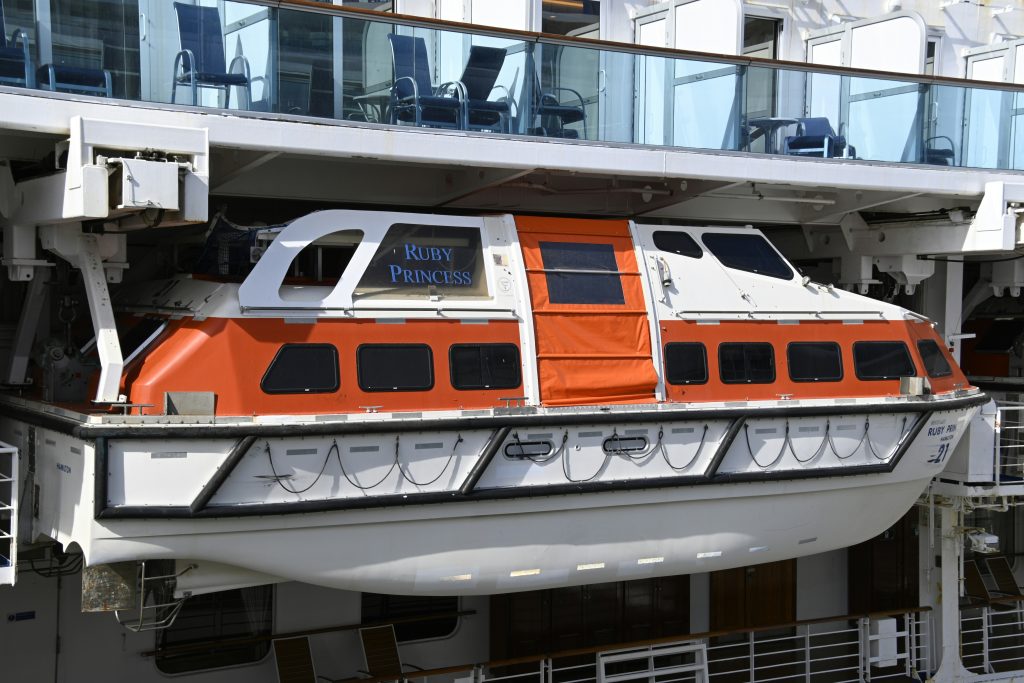
Lifeboats are enclosed, motorized vessels capable of keeping passengers safe for extended periods. They are boarded from a designated deck clearly marked throughout the ship.
Life rafts are inflatable and deployed if lifeboats cannot be used. They are stored in canisters along the ship’s outer deck and are designed to deploy automatically if the ship sinks.
What to do when boarding a lifeboat:
- Follow the crew’s direction on boarding order — there is an established sequence and it exists for good reason
- Do not rush — lifeboat boarding is designed to be orderly and rushing creates dangerous confusion
- Help elderly passengers, children, and anyone with mobility difficulties if you are safely able to do so
- Leave large bags behind — one small bag with essential items is the maximum. A waterproof document and phone pouch is worth keeping packed with your passport copy, insurance card, and a card with emergency contacts — ready to grab in exactly this situation.
Fire on Board — What Passengers Need to Know
Fire is the most common serious emergency on cruise ships. Modern ships have extensive fire suppression systems, but passenger awareness still matters significantly.
- Never prop open cabin doors — fire doors are your primary protection against smoke and fire spreading through corridors
- If you smell smoke, call the front desk immediately — do not go looking for the source yourself
- Feel your cabin door before opening it — if it is warm, do not open it. Call for help and signal from your window or balcony
- Stay low in a smoke-filled corridor — smoke rises and cleaner air stays near the floor
- Know where the fire extinguishers are on your deck — they are mounted in corridor alcoves at regular intervals and are clearly marked
Medical Emergencies at Sea
Cruise ship emergency procedures include medical response — every ship sailing with a significant number of passengers is required to have a medical facility and licensed medical staff on board. Modern large cruise ships carry doctors and nurses equipped to handle most emergencies.
What passengers frequently don’t know:
- Shipboard medical care is not free — it is billed like a private hospital visit and can be expensive without insurance coverage
- Medical evacuation from international waters is extraordinarily expensive without coverage — a helicopter evacuation alone can cost $50,000 or more
- Travel insurance with medical evacuation coverage is not optional — it is essential for every cruise passenger, particularly anyone with existing health conditions
This is exactly why I recommend travel insurance on every single cruise without exception. A medical emergency at sea without coverage can be financially devastating. With the right coverage it becomes a manageable situation that the ship’s medical team handles professionally.
RoamRight Travel Insurance — Get a Quote →
If Someone Goes Overboard — What to Do
If you witness a passenger going overboard:
- Shout “man overboard” loudly and repeatedly to alert nearby passengers and crew
- Keep your eyes on the person in the water at all times — do not look away, point continuously toward where they are
- Throw any available flotation device toward them — life rings are mounted at regular intervals along the outer deck railings
- Send someone to find a crew member immediately while you keep visual on the person in the water
- Remember your location — deck number, which side of the ship, how far from the back of the ship
Do not jump in after them. This creates a second emergency and significantly reduces the chance of survival for both people.
Before You Board — Your Pre-Cruise Emergency Checklist
- Watch the safety video completely and attentively before your muster station check-in
- Walk the physical route from your cabin to your muster station on boarding day
- Locate the life jackets in your cabin and practice putting one on
- Find the nearest life jacket storage on your deck outside your cabin
- Save the ship’s emergency number in your phone — it is posted in every cabin
- Bring a portable charger — your phone is your emergency contact, your map, and your camera all day. Don’t let it die in port.
- Purchase travel insurance with medical evacuation coverage before departure
- Talk to any children in your group about where to go and what to do if you get separated
- Identify the two nearest emergency exits to your cabin
Conclusion
Cruise ships are among the safest ways to travel in the world, and cruise ship emergency procedures are a big reason why. The emergency systems, crew training, and international safety regulations surrounding cruise ship safety are genuinely impressive — and as someone trained in federal emergency management I mean that without any qualification.
What this article gives you is not a reason for anxiety — it’s a plain-English guide to cruise ship emergency procedures that takes five minutes to read. It’s the five minutes of preparation that means if something unexpected happens on your next cruise — however unlikely — you are the passenger who knows exactly what to do.
That preparation is the difference between a passenger who helps keep things calm and orderly and one who adds to the confusion.
Before your next port stop, make sure you’re also prepared on land: 10 Cruise Port Safety Tips From a Retired NYPD Officer
And if Nassau is on your itinerary: Is Nassau Bahamas Safe for Cruise Passengers? A Law Enforcement Perspective
Travel safe. Enjoy every moment at sea.
Found this helpful? Share it with everyone in your travel group before your next cruise. And subscribe to the Travel Safety Authority newsletter for more practical travel safety guides delivered straight to your inbox.
This article contains affiliate links. If you purchase, book, or make a reservation through a link on this page, I may earn a small commission at no additional cost to you. Affiliate relationships include but are not limited to Amazon Associates, Viator, RoamRight, and other travel and product partners. This does not influence my recommendations — I only link to products, services, and experiences I would genuinely recommend to my own clients. Travel insurance recommendations are provided for informational purposes only. I am not a licensed insurance agent. Please review all policy details carefully before purchasing. See my full Disclaimer for details.
The information in this article is provided for general educational purposes only and reflects the personal experience and professional background of the author. It is not a substitute for professional security consultation or official government travel guidance. Safety conditions at any destination can change rapidly — always verify current advisories at travel.state.gov before your trip. Reliance on any information in this article is at your own risk. This site may contain affiliate links; see the full Disclaimer for details.