Cruise Cabin Types Explained: Which Cabin Should You Book?
Current as of November 2026. Cabin categories, perks, and age rules change, so confirm the details on the cruise line’s own stateroom page before you book.
Cruise lines divide their cabins into four main types: interior, ocean view, balcony, and suite. But the type of cabin is only part of the decision. Where it’s located, what privileges come with it, and whether you get to choose your exact room all matter. This guide to cruise cabin types explains what each includes, where the in-between categories fit, and which cabin is worth paying for.
Booking a cruise comes down to four decisions: which cruise line, which region or itinerary, when to sail, and which cabin. This article is my guide to picking the best cabin. My guide to booking a cruise covers all four decisions, and the other three each have their own guide: how to choose a cruise line, where you want to sail, and the best time to go on a cruise. A separate guide to cruise deposits, final payment, and booking perks covers paying for the booking.
What Are the Cruise Cabin Types?
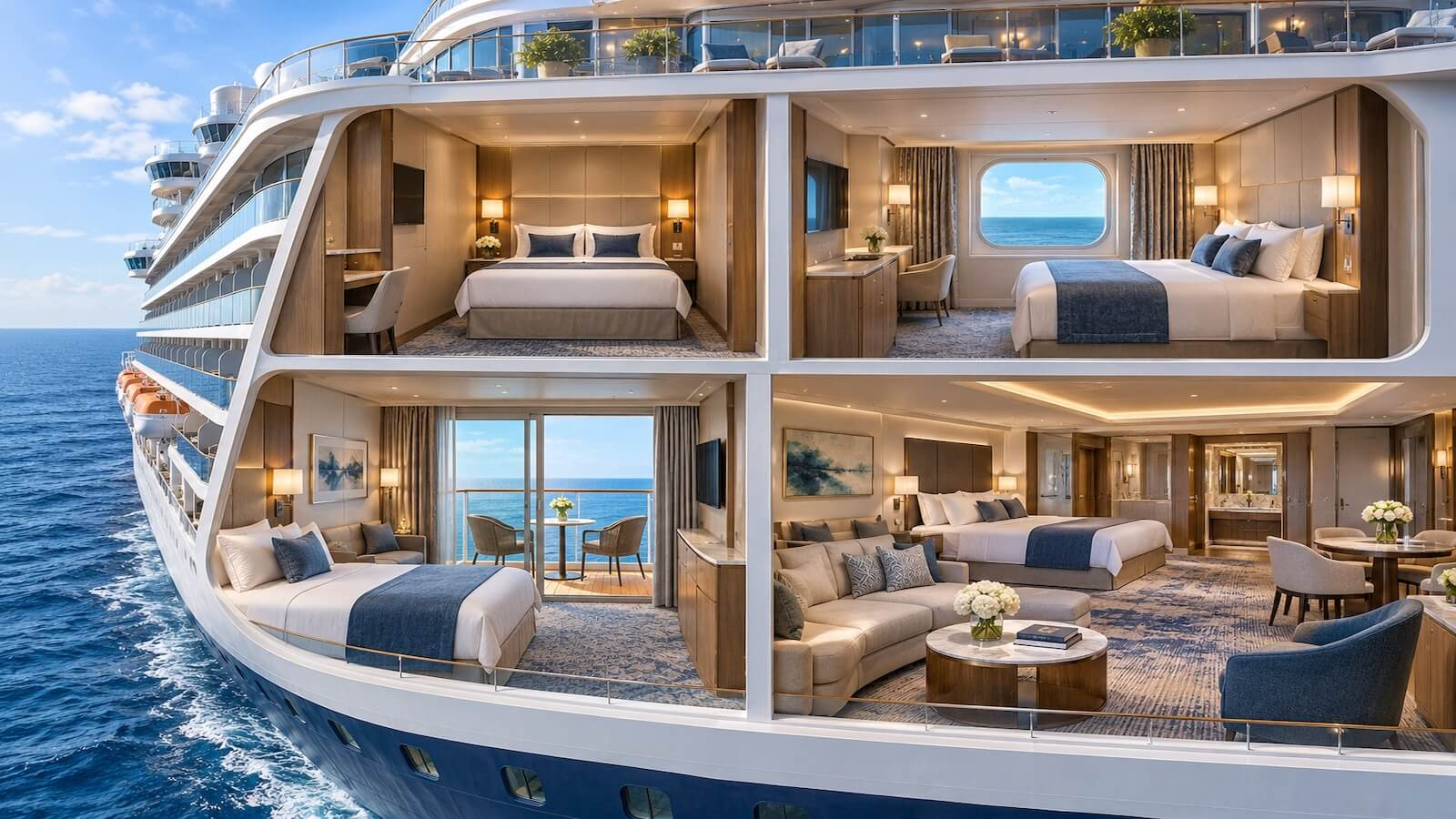
Cruise ships sell four main cabin types. An interior has no window, an ocean view has a window or porthole but no outdoor access, a balcony has a private outdoor space, and a suite adds more space and privileges. Every cruise line divides these into smaller categories, and the details change from ship to ship.
Two cabins sold under the same category can differ in size, shape, and location, so check the deck plan and listed size for the specific room number you’re booking.
Interior
Interior cabins are usually the smallest and least expensive on the ship, with most measuring around 160 square feet.
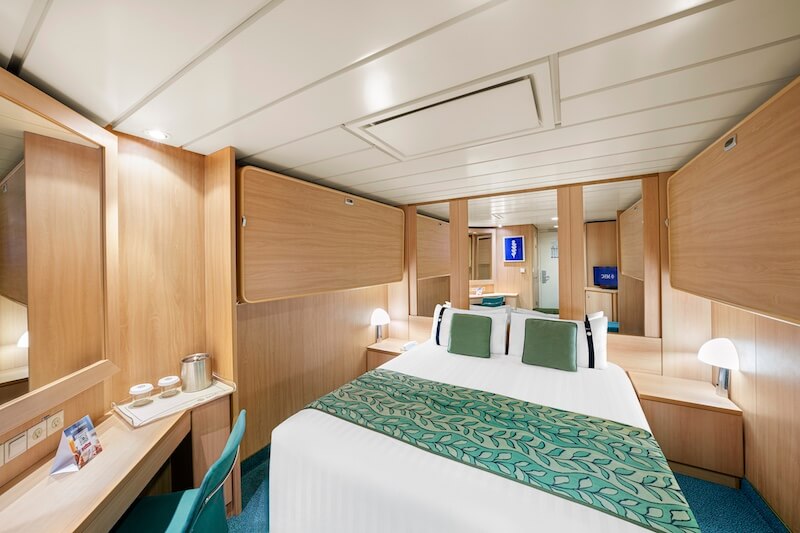
Some ships have larger interiors designed for families. Royal Caribbean’s Spacious Interiors can connect to a neighboring cabin, while Norwegian Breakaway’s Family Inside cabins are located near the kids’ area. An interior in a low, midship location can also be a better room than a cheaper exterior cabin at the far forward or aft end, where you feel more of the ship’s motion.
Is an Interior Cabin Worth It?
An interior cabin is worth it if you mostly use the room to sleep and shower. It’s the cheapest option, and the lack of windows keeps it dark. If you prefer daylight or feel closed in without a window, it may not be for you. The money you save can go toward excursions, dining, or a better cabin location.
Without a balcony door or window, you won’t have wind, music, or crowd noise coming in from the open decks. You can still hear footsteps and chairs sliding on the deck above, so check what’s directly overhead on the deck plan before booking. If you’re out of the room from breakfast until dinner, you won’t miss the window.
Insider Tip: An interior can be the better pick for reasons beyond price. If you like to sleep in total darkness, or you need a quiet nook to unwind when crowds and noise on a ship overstimulate you, a windowless room is the right call.
Ocean View
An ocean view cabin gives you natural light and a view of the water, but no outdoor access. Princess, for example, offers ocean view cabins ranging from approximately 146 to 212 square feet, depending on the ship and category. Windows range from small portholes to larger picture windows.
Is an Ocean View Cabin Worth It?
Ocean view is often the weakest value of the four types. You’re paying extra for daylight and a view of the water. I’d choose one when the price is close to an interior, or when a balcony costs considerably more. Compare all three on the same sailing before you decide.
Insider Tip: Price an interior, an ocean view, and a balcony side by side for the same ship and sailing date. If the ocean view fare sits closer to the balcony than to the interior, the balcony is usually the better buy. If it sits close to the interior, the window can be worth the small step up.
Balcony
A balcony cabin gives you your own outdoor space, with most cabins totaling around 200 square feet including the room and balcony. On Royal Caribbean, a standard balcony averages about 50 square feet, with larger ones around 80.
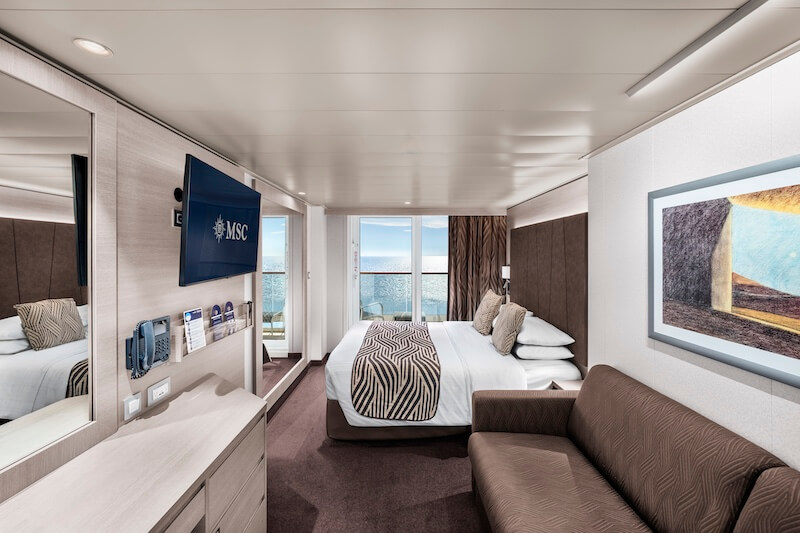
Don’t assume every balcony overlooks the ocean. Some face indoor neighborhoods, while others have a partially blocked view. Check the deck plan to see what’s above, below, and beside your cabin, and ask the cruise line about the view before booking.
Is a Balcony Cabin Worth the Extra Cost?
A balcony is worth the extra cost if you’ll use it: morning coffee, quiet time away from the crowds, or scenery you don’t want to miss. If you’re at the pool or ashore most of the day, you’ll use it less. Divide the price difference by the number of nights to see what you’re paying per night for the upgrade.
A balcony adds the most on scenic routes such as Alaska and the Scandinavian fjords. On those sailings, I’d book the side that faces the coastline. The best side depends on the direction the ship travels, so check the itinerary before you choose. My guide to choosing a cruise itinerary covers what each destination offers.
Suite
Booking a suite gets you extra space, but the real draw is often the added privileges. Depending on the cruise line and suite tier, you might get priority boarding, private lounge access, a concierge or butler, and included dining or drinks. Those benefits can vary quite a bit between suite categories, even on the same ship.
Is a Suite Worth It on a Cruise?
A suite is worth the splurge if you’ll use what comes with it. Before you book, do the math: how much would you spend buying those extras separately? If you spend most of your days at the pool or exploring ports, you might find you’re paying a lot more for a room you barely use.
Are Junior Suites Worth It?
Junior suites can be worth the extra cost if you want more room than a standard balcony cabin without paying full-suite prices. Whether the upgrade makes sense depends on the price difference, how much you’ll use the extra space, and what else comes with it. Some junior suites offer worthwhile perks, while others are little more than larger balcony cabins.
Is a Junior Suite a Real Suite?
Usually not when it comes to privileges. A junior suite may give you a larger room and a balcony, but that doesn’t mean you get the private lounges, concierge service, or dining benefits available with higher suite tiers. Some cruise lines include a handful of extras; others mainly give you more space.
What Do Junior Suites Include on Different Cruise Lines?
| Cruise line | Cabin category | What’s included |
|---|---|---|
| Royal Caribbean | Junior Suite (Sea tier) | Dedicated check-in, priority boarding, and Coastal Kitchen dinner when space allows. No Suite Lounge access or included gratuities. |
| Royal Caribbean | Sky Junior Suite (Sky tier) | Adds Sky tier privileges, including concierge service and Suite Lounge access. |
| Princess | Mini-Suite | A larger room, a separate sitting area with sofa bed, two flat-screen TVs, and a welcome glass of champagne. Many also have a bathtub and shower combination. Amenities and layouts vary by ship. |
| Princess | Reserve Collection Mini-Suite | Adds Reserve Dining, a premium location, and wine on arrival. |
| Norwegian | Club Balcony Suite | Earlier dining reservations (up to 125 days before sailing), one valet laundry service, sparkling wine, and treats twice per voyage. Sold alongside balcony staterooms. |
If you’re mainly looking for more space, a junior suite may be all you need. If you’re hoping for private lounges, dedicated service, and the other extras associated with full suites, make sure the category you’re paying for actually includes them.
Other Cruise Cabin Types and Variations
Not every cabin fits neatly into the four basic types. Some have unusual views, others use a different balcony design, and a few offer features you might not expect in an interior cabin.
What Is an Obstructed-View Cabin?
An obstructed-view cabin is an ocean view or balcony cabin where a lifeboat, support structure, or other part of the ship blocks some or all of the view. It usually costs less than a clear-view cabin in the same category. Deck plans often don’t show how much is blocked, so ask the cruise line before you book.
A guarantee booking can also leave you with an obstructed view, since the cruise line chooses your cabin location. That’s a possibility with both Royal Caribbean and Norwegian, among other cruise lines.
Infinite Verandas and Infinite Balconies
An Infinite Veranda gives you fresh air without a traditional outdoor balcony. Instead, a large window lowers at the touch of a button, opening the space to the outside. Close it, and that area becomes part of your cabin.
On Celebrity’s Edge Series, a standard Infinite Veranda stateroom measures 243 square feet, including a 42-square-foot veranda. Royal Caribbean has a similar design on its Icon Class ships called the Infinite Balcony, which adds up to 50 square feet of indoor living space when closed.
The cabin isn’t necessarily bigger overall. With the window closed, you have more air-conditioned living space instead of a separate outdoor balcony. That’s why Celebrity’s Edge Series Infinite Veranda cabins have 23% more indoor space than traditional Solstice Series veranda cabins. You’re gaining indoor living space, not an additional 23% in total cabin size.
If you enjoy sitting outside with your morning coffee or watching the scenery from your own balcony, this isn’t quite the same experience. You can open the window for fresh air, but you can’t step outside onto a separate balcony.
What Is a Virtual Balcony?
A virtual balcony is a large screen inside an interior cabin that shows a live view of the sea and ports. It can make a windowless room feel less closed in, but it’s still a screen, not a window. You won’t get natural light or fresh air.
Royal Caribbean’s virtual balconies use an 80-inch, nearly floor-to-ceiling HD screen showing a live view from outside the ship. The scenery changes as the ship moves, although you might find yourself looking at a terminal building instead of the ocean when you’re in port. If you want the screen turned off, you’ll need to ask your cabin steward. You can close the curtains, but the room won’t be completely dark while the screen is on.
A virtual balcony offers a bit of both if you like the darkness of an interior cabin but wish you could see what’s happening outside. They’re available in select interior cabins on some Royal Caribbean ships. Disney’s Magical Portholes on Disney Dream and Disney Fantasy offer a similar experience.
Neighborhood-Facing Balconies and Promenade-View Cabins
On Royal Caribbean’s Oasis and Icon Class ships, some balconies overlook neighborhoods such as Central Park, the Boardwalk, or Surfside. MSC’s World Class ships also offer balconies overlooking the World Promenade, including some with partial ocean views.
Some Royal Caribbean ships have Promenade View cabins, which are interior cabins with windows overlooking the indoor Royal Promenade rather than the sea.
These rooms give you a view of the activity around the ship, but privacy is worth considering. If you can see people across the neighborhood or promenade, they may be able to see into your cabin too.
Suites and Ship-Within-a-Ship: What the Privileges Actually Buy
Some suite categories give you access to private restaurants, lounges, and deck areas within the ship. But that access comes with restrictions on who can use them.
What Is a Ship-Within-a-Ship Suite?
A ship-within-a-ship suite gives you access to private lounges, restaurants, and deck areas while still letting you enjoy the rest of the ship. Norwegian’s Haven and MSC Yacht Club are the clearest examples. Only guests booked in those suites can use the private areas, so travelers in regular cabins can’t join you there.
Norwegian’s Haven includes a private sundeck and courtyard with a pool and hot tubs, a concierge, 24-hour butler service, and priority reservations for dining and entertainment. On Prima, Epic, Breakaway, and Breakaway Plus class ships it also includes a private Haven Lounge and Haven Restaurant, so the setup varies by ship class.
The MSC Yacht Club offers a butler, a concierge, a private restaurant, lounges, and a secluded pool deck and solarium. Only Yacht Club guests have access. If your party includes people booked in regular cabins, they can’t use those spaces, even as your guests. Celebrity’s Retreat and the Suite Neighborhood on Royal Caribbean’s Icon Class are comparable products.
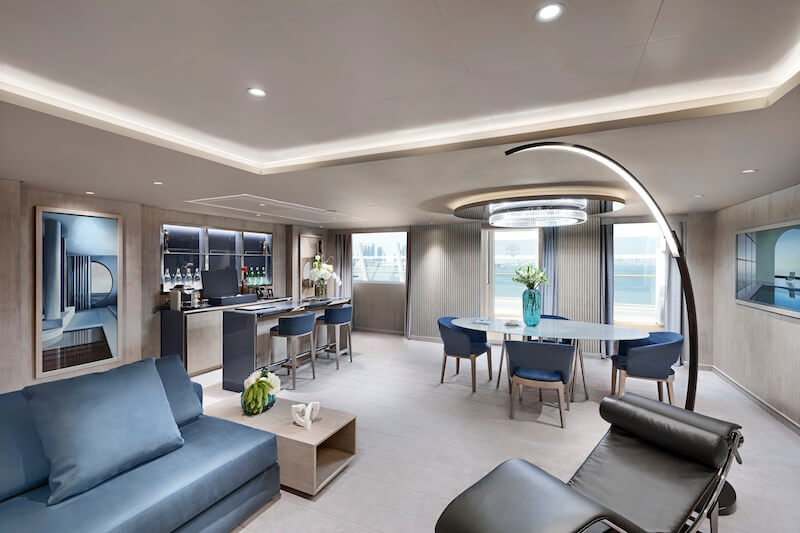
Families can book these suites too. Children of all ages are welcome in the MSC Yacht Club, and Norwegian’s Haven includes a two-bedroom family villa that sleeps up to six. The Haven Sundeck is restricted to guests 16 and older, so ask Norwegian which areas children can use.
Inside, the private areas can feel like a smaller, quieter ship. The moment you leave them, you’re on a large ship sharing its crowds. My guides to The Haven by Norwegian and the MSC Yacht Club go further.
What Top Suite Tiers Include
At the highest suite tiers, the fare can include drinks, specialty dining, and services that other passengers pay extra for. Royal Caribbean’s Star tier includes the Deluxe Beverage Package for guests 21 and older, gratuities for standard dining, stateroom, and housekeeping staff, complimentary dining at most specialty venues, and Royal Genie service. A Royal Genie arranges things like dining reservations, prime seats at shows, and luggage handling on embarkation day.
Virgin Voyages’ RockStar Quarters work differently. Both tiers get Richard’s Rooftop, a members-only sundeck, and a team of RockStar Agents on hand to help. Only the Mega RockStar tier gets a dedicated agent, included access to the spa’s Thermal Suite, a bottomless in-room bar, and a bar tab for drinks and wine around the ship, with limits.
Luxury cruise lines such as Regent sell only suites, from about 300 to more than 4,000 square feet, so “suite” is simply the name for every room there.
Cabins With Exclusive Access and Perks
On some ships you can use certain areas only if you book the right cabin. Carnival’s Havana staterooms come with access to the Havana Bar and Pool area, and every guest in a Havana stateroom must be 12 or older. Carnival’s Cloud 9 Spa staterooms carry spa privileges, including priority spa reservations, free fitness classes, and unlimited thermal suite access.
Two cabins at similar prices can buy different access depending on the cruise line, so read what the category includes as well as what it costs.
Do Suites Have Different Deposits?
Suites can carry a different deposit than other cabins. Royal Caribbean suites ask for 10% of the fare or the standard deposit, whichever is higher, and Norwegian’s Haven asks for 10%. My guide to cruise deposits and final payment explains how deposits work.
Cabins for Solo Travelers, Families, and Groups
Solo travelers, families, and groups face rules a standard double cabin doesn’t: pricing, sleeping limits, and who can stay in a room without a parent.
Solo and Studio Cabins
Booking a standard cabin alone commonly means paying 200% of the per-person fare because the cruise line prices the room for two. That’s a 100% single supplement. Solo categories avoid that, and solo options now go beyond the smallest interior. Norwegian’s solo staterooms include Solo Inside, Solo Oceanview, and Solo Balcony on its fleet, plus Solo Studio on select ships, all priced for one guest.
Norwegian’s Studio Lounge is the social space for solo travelers, and all solo staterooms include access.
Princess sells a limited number of single-occupancy interior cabins on its newest ships, and they sell quickly. Solo cabins are limited in number, so they tend to be among the first categories to sell out.
Should You Book Connecting Cabins?
Connecting cabins are two cabins joined by an inside door, so a family or group gets two bathrooms and two sets of beds. They often cost less than a comparable suite. The door locks from both sides, so each room keeps its privacy when it’s closed.
Newer ships sell more family layouts. Icon Class has family rooms and connecting setups through private foyers. Royal Caribbean’s Family Infinite Ocean View Balcony sleeps up to six, with a split bathroom and a kids’ bunk room, and connects through a private vestibule. Celebrity’s Edge Class ships were designed with 178 connecting options, and MSC World America has two- and three-cabin connecting setups. On Carnival, Family Harbor staterooms sit near the Family Harbor Lounge, and kids eat free at most specialty restaurants. Check the ship’s cabin categories and deck plan for the available family and connecting layouts.
Book both rooms by room number at the same time. If you book them one after the other, the second one may not be next to the first.
Age Rules When Kids Have Their Own Cabin
Cruise lines have their own rules for children and teens in a separate cabin, and the rules differ by cruise line.
- Royal Caribbean: On sailings that begin in North America, Royal Caribbean won’t assign anyone under 21 to a stateroom unless a guest 21 or older is in it. The exception is a child sailing with a parent or legal guardian in a connecting or adjacent stateroom, or one directly across the hall.
- Norwegian: Anyone under 21 must share a stateroom, or a connecting or adjoining one, with a guest 21 or older.
- Carnival: Guests must be 21 to travel on their own, and guests under 21 need a relative or guardian 25 or older. Children 12 and younger booked in a separate cabin must be next door or across the hall, and they can’t stay in a balcony cabin without that adult in it. Teens 13 to 17 can be up to three staterooms away. Since February 1, 2025, Carnival also requires cabin numbers to be assigned to travelers under 21.
Rules also change by sailing region, so confirm them for your sailing before you book rooms for teens.
How Many People Can Sleep in a Cruise Cabin?
Listed capacity counts every berth, including third and fourth beds, Pullman beds, and sofa beds. A cabin listed for four may be comfortable for two adults and two children but cramped for four adults. Check the bed setup and the cabin size before you count on a full house.
A Pullman is a bed that folds down from the ceiling or wall above the main bed, and you reach it by ladder. Royal Caribbean’s Pullman beds are not for children under 6, guests over 78 inches tall or 300 pounds, or guests with mobility issues. A third- or fourth-guest-free offer only helps if the cabin has the berths.
What Should You Know Before Booking an Accessible Cabin?
On cruises that board at U.S. ports, accessible cabins are held for travelers who need them until the other cabins in that class are sold. You don’t have to prove a disability, but the cruise line can ask you to confirm that you need the features. Booking early gives you more choice of ship, cabin, and sailing.
Under 49 CFR § 39.39, cruise lines must describe each accessible cabin’s features in enough detail for you to determine whether it meets your needs. If no accessible cabin is available in your chosen class but one is available in a more expensive class, 49 CFR § 39.43 protects you from having to pay the higher fare.
Royal Caribbean’s accessible staterooms have doors 32 to 34 inches wide, no doorsill, ramped bathroom thresholds, grab bars, roll-in showers with benches, lowered sinks and closet rods, and a five-foot turning radius. Guests who book one complete its Guest Special Needs Form. A guest who doesn’t need the features can be moved to another cabin to make room for someone who does.
My guides to cruising with a wheelchair and cruising with a disability go deeper on what to ask for.
Does Cabin Location Matter?
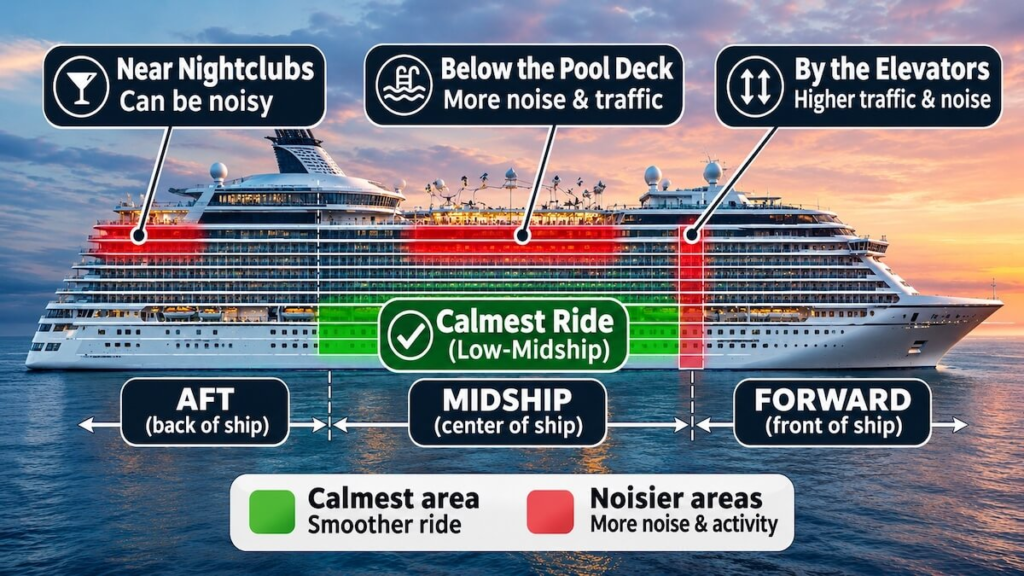
Two balcony cabins in the same category can feel different depending on where they sit. How much movement you feel, how much noise you hear, and how far you walk to the elevators all depend on the cabin’s location.
Which Cruise Cabin Is Best If You Get Seasick?
If you’re prone to seasickness, I’d choose a cabin on a lower deck near the middle of the ship, where you’ll feel the least movement. Higher decks and cabins toward the front or back tend to move more, especially in rough seas. The CDC also recommends avoiding the bow, where movement is greatest.
Medication works best when you take it before symptoms start, and avoiding alcohol and nicotine and getting enough sleep help. Ask your doctor about medication before you sail. If worry about the motion is part of what’s holding you back, my guide to fear of cruising looks at what the data says.
What Are the Noisiest Cruise Cabin Locations?
The noisiest cruise cabin locations are the ones next to or beneath busy spaces:
- Directly below the pool deck or sun deck
- Above or below a nightclub
- Near restaurants
- Near theaters
- Beside the guest elevators
- Next to crew elevators or service corridors, which mostly affects interior cabins
Check the deck plan above, below, and beside the cabin you’re considering. On some ships, low forward cabins can hear bow thruster and anchor operations, and aft cabins can feel vibration. Those tendencies vary by ship, and there’s no universal best deck.
Is a Cabin Near the Elevators a Good Idea?
You’re trading convenience against hallway noise. A cabin two or three doors from the elevators keeps most of the convenience and cuts most of the noise. It matters most if you have limited mobility or you’re traveling with small children or a stroller.
What Is a Guarantee Cabin?
A guarantee cabin is a booking that confirms a cabin category, such as balcony, but lets the cruise line choose the exact room later, sometimes just before sailing. It usually costs less, but you give up control over location, and in some cases the view.
Royal Caribbean assigns the stateroom at its discretion, at any time up until port check-in. The cabin may have an obstructed view, and your party may not be placed together. On Oasis and Icon Class ships, a balcony guarantee can land you on a Neighborhood View Balcony.
Norwegian assigns guarantee staterooms any time after final payment and up to the day of sailing. Its guarantee doesn’t cover an unobstructed view, a deck or location, or a specific stateroom number, and Norwegian doesn’t recommend guarantees if you need a specific deck, window, or elevator proximity.
You might get upgraded to a higher cabin category, but it’s never guaranteed. Royal Caribbean guarantees the minimum category you booked and may, at its discretion, upgrade you to a superior one. Norwegian’s guarantee covers the category you paid for or possibly a higher one, and the rate doesn’t promise an upgrade.
MSC assigns guarantee cabins at the lowest fare level within four days of departure. The cabin could be obstructed or promenade view, and MSC may split a party of three or four across two cabins.
A guaranteed balcony gets you a balcony somewhere on the ship, but not necessarily an ocean view or a good location. If the view matters to you, book a specific room.
Can You Bid to Upgrade Your Cruise Cabin?
Some cruise lines let you bid to move up a cabin category after you book. Royal Caribbean’s Royal Up and Norwegian’s Upgrade Advantage are the main examples. You choose how much to bid, and the cruise line decides whether to accept your offer. If your bid isn’t accepted, you keep your original cabin.
Royal Up can move you from an ocean view or balcony to a larger suite. You check your eligibility with your last name and reservation ID, then choose what you’d pay for each upgrade. Bids are per person and assume two guests per stateroom, so you’re charged for the first two guests only. You can bid on several rooms but pay only for the one you receive, and Royal Caribbean emails you if a bid is approved.
Norwegian’s Upgrade Advantage works on a per-person bid that covers the whole cruise and is added to your original fare. Only the first two guests on a reservation are charged. Each cabin needs its own bid, and Norwegian reviews each bid individually, so it can’t promise that everyone in your party is upgraded or that upgraded cabins are near each other. You can’t choose a cabin number. A bid can be accepted anytime from the day you submit it until the day of departure, and once it is, your card is charged immediately and the payment is non-refundable.
Why Booking Early Matters More for Some Cabins Than Others
Booking early protects your choice of cabin. It doesn’t guarantee a lower price, and there’s no magic number of months. Some cabin categories sell out long before the ship does, including solo cabins, accessible cabins, aft and corner balconies, and ship-within-a-ship suites. Connecting and family layouts are limited in number too.
Ships have limited numbers of these cabins, and for some passengers, a standard room isn’t a suitable alternative.
Cruising With Kids? What to Know About Your Balcony
Federal law sets a minimum height for balcony rails. 46 U.S.C. § 3507 requires ship rails at least 42 inches above the cabin deck on passenger ships authorized to carry 250 or more passengers that embark or disembark passengers in the United States. The rule is meant to prevent accidental falls, and the same height applies to pool and sun deck railings.
A rail height rule doesn’t replace supervision. If you have younger children, keep the balcony door locked whenever an adult isn’t watching them, and keep chairs and anything a child can climb away from the rail.
What Should You Check Before You Book a Cabin?
When you compare cruise cabin types, look beyond the price. Check what’s included with the exact category, the size and location of the specific room, and whether the cabin you want is in limited supply. If it is, book early.
Next Steps
After you book, the 90-day cruise checklist lays out the preparation timeline. The guide to documents needed for a cruise covers the paperwork that gets you onboard.
Travel safe.
— Rick Hayes, Travel Safety Authority
Conditions change fast. Verify current advisories at travel.state.gov before your trip. This article is general information based on my experience, not professional security advice. See the full Disclaimer.