Cruise Deposits and Final Payment: Refunds, Deadlines, and Booking Perks
Current as of November 2026. Deposit amounts, payment deadlines, and promotions change often, so confirm the numbers on the cruise line’s own page before you book.
A cruise deposit reserves your cabin for just a few hundred dollars per person, but that’s only the first payment. The remaining balance is due on a set date, and if you miss that deadline, the cruise line can cancel your booking. Deposit amounts, refund rules, and payment deadlines vary by cruise line. Promotional offers have their own restrictions, too. If you cancel and rebook, you could lose benefits that came with your original reservation. Even the choice between a refundable and non-refundable deposit can affect the price. The examples here come from my own bookings, including a side-by-side fare comparison and a Royal Caribbean invoice.
Booking a cruise involves four decisions: which cruise line, where you want to sail, when to sail, and which cabin to choose. This article covers the money side of booking. My guide to booking a cruise walks through all four decisions. You can also read more about choosing a cruise line, choosing an itinerary, and the best time to go on a cruise. The cruise cabin types guide also covers suite deposits.
How Much Is a Cruise Deposit?
Cruise deposits vary by cruise line, sailing length, and cabin category. On mainstream cruise lines, deposits start at around $100 per person for shorter cruises and can reach several hundred dollars for longer sailings. Some cruise lines charge a percentage of the fare instead, particularly for suites.
Cruise Deposit Amounts by Cruise Line
The table below compares deposit amounts across mainstream cruise lines, with links to their official policies where available. Amounts are per person unless noted. Since deposits can change, always confirm the amount with the cruise line before booking.
| Cruise line | Deposit |
|---|---|
| Royal Caribbean | $100 (1 to 5 nights), $250 (6 to 9), $450 (10 to 14), $500 (15 or more). Bermuda sailings are a flat $250. Suites are 10% of the fare or the standard deposit, whichever is higher. For reservations made on or after September 29, 2026 on Alaska, Hawaii, Transpacific, Panama Canal, and Pacific Coastal sailings departing on or after April 11, 2028, cruises of 10 nights or longer are $450. |
| Norwegian | $100 (1 to 6 days), $250 (7 or more). The Haven and suites are 10% of the voyage fare. |
| Carnival | $100 (2 to 3 days), $150 (4 to 5), $250 (6 to 9), $400 (10 or more). Alaska, Europe, Panama Canal, transatlantic, and transpacific sailings are $400. |
| MSC | $99 (4 nights or fewer), $199 (5 to 14), $300 (15 or more). |
| Virgin Voyages | 20% of the voyage fare, whatever the length or cabin. The fare for this purpose excludes taxes and fees. |
| Disney | About 10% of the fare. The amount is set when you book. |
| Princess | Changed with the policy that took effect September 2, 2026. On cruises of 45 days or more, 10% at booking and another 20% at 320 days out. Check your booking for shorter sailings. |
Percentage-based deposits are more common with luxury cruise lines. If you book inside the final payment window, you pay the full fare when you book. There’s no deposit stage.
Paying a Norwegian Deposit With CruiseFirst or CruiseNext
Norwegian lets you pay your deposit using credits you’ve already purchased. CruiseFirst certificates are bought in advance. A standard $150 certificate gives you $300 toward a deposit, and promotions can increase that value, such as paying $250 for a $500 certificate.
CruiseNext credits work differently. You buy them onboard a Norwegian cruise, and a single $250 credit covers the entire deposit for a Studio, Inside, Oceanview, Balcony, or Club Balcony stateroom.
For a Suite or The Haven, that same $250 credit covers only part of the deposit. You’ll need the $500 CruiseNext Haven Credit to cover it in full. These credits apply to new reservations on sailings of three days or longer, with a limit of one per stateroom.
What Does a Reduced Deposit Mean?
A reduced deposit means paying less upfront, not necessarily paying less for the cruise. It doesn’t change your total fare, your refund rules, or your final payment date. Some reduced deposits are also non-refundable and non-transferable, including Carnival’s 50% reduced-deposit promotion.
Before booking, check how much you’re paying today, the total fare, whether your deposit is refundable, and when cancellation penalties become greater than the deposit you’ve paid.
The promotion’s terms matter here. Carnival’s Early Saver deposits are non-refundable. Princess limits the first cancellation fee on reduced-deposit promotions to the amount of the deposit paid. Even with a smaller deposit, the fare can have strict cancellation rules, and you’ll need to check the promotion’s terms to see whether the final payment date changes.
Refundable vs. Non-Refundable Cruise Deposits
Many cruise lines offer the same cabin at two different prices. The lower fare comes with a non-refundable deposit, while the higher fare lets you cancel before final payment and get your deposit back. You’re paying more for flexibility, and what happens if you cancel a non-refundable booking depends on the cruise line.
Is a Cruise Deposit Refundable?
It depends on the fare you choose. With a refundable deposit, you get your money back if you cancel before final payment. A non-refundable fare costs less, but you give up that refund. What happens to the deposit after cancellation varies by cruise line, so check the fare rules before booking.
Here’s how the major cruise lines handle cancellations:
- Royal Caribbean: On non-refundable deposit fares, the deposit becomes the cancellation penalty if you cancel before final payment, and any additional payments are refunded. Changing the ship or sailing date costs $100 per guest each time. Refundable fares let you make those changes without a fee.
- Carnival: Cancel an Early Saver fare before final payment, and you receive a future cruise credit equal to your deposit minus a $50 per-person fee. That credit is valid for 12 months under Carnival’s cancellation policy. Super Saver and casino fares can have non-refundable deposits, while Pack & Go fares can be fully non-refundable.
- Princess: Non-refundable deposits became the default for most new bookings on October 15, 2025, with refundable deposits available at a higher cost. For bookings made on or after September 2, 2026, the deposit becomes the cancellation charge if you cancel 120 or more days before sailing, unless you purchased the refundable option.
- Virgin Voyages: Lock It In and Base fares are non-refundable from the day you book. Higher fare tiers have different rules, and most protections become more limited within 45 days of sailing.
- Norwegian: Standard and Haven deposits are refundable until final payment, which is due 120 days before sailing.
The same distinction applies at the luxury end. Silversea also offers refundable and non-refundable fare tiers.
A Dated Example of the Price Gap
I priced this on a mock booking on September 18, 2026: a 4-night Adventure of the Seas sailing departing August 16, 2027. The refundable fare was $2,738 and the non-refundable fare was $2,235. The refundable fare cost about 22% more. Those numbers belong to that sailing and that date, so price both fares on your own sailing.
When Is Final Payment Due on a Cruise?
Mainstream cruise lines typically require final payment 75 to 120 days before departure, depending on the cruise line and sailing length. Luxury and expedition cruise lines often require payment earlier. If you book after the final payment deadline, you pay the full fare when you book.
The table starts with mainstream cruise lines, followed by several others for comparison.
| Cruise line | Final payment due (days before departure) |
|---|---|
| Carnival | 76 (2 to 5 day cruises), 91 (6 days or more, plus Alaska, Europe, Panama Canal, and transatlantic) |
| Royal Caribbean | 75 (1 to 4 nights), 90 (5 to 14), 120 (15 or more) |
| Norwegian | 120 on every sailing |
| MSC | 75, 90, or 110 depending on length; 120 for World Cruises |
| Princess | 120 for cruises of 1 to 44 days, on bookings made on or after September 2, 2026. Earlier bookings were 90 days for 13 nights or fewer. |
| Celebrity | 90 (your date is set at booking, so confirm it on your booking) |
| Holland America | 90 for most cruises of 13 days or less, 120 for longer ones and for Asia, Australia, and South America. Depending on when you booked, some shorter cruises run 120 too. |
| Disney | 90 (5 nights or fewer), 120 (6 nights or more). The date is set at booking. |
| Virgin Voyages | 120 on every sailing |
| Contrast group | Oceania, Regent, Silversea, and Azamara: 150. Viking: 180, up to 18 months on some bookings. Celestyal: 60, the shortest. Ritz-Carlton Yacht Collection: 180. |
Promotions and Cabin Category Can Affect the Date
Promotional fares can have different final payment deadlines than the standard schedule, so always check your booking. Royal Caribbean determines the deadline by sailing length rather than cabin category. That means a suite and a balcony on the same sailing have the same final payment date, even though their deposits differ. Some luxury cruise lines require earlier final payment for premium cabin categories.
Princess Changed Its Final Payment Rules in September 2026
Princess now requires final payment 120 days before departure for cruises of 1 to 44 days. This applies to bookings made on or after September 2, 2026. If you booked before September 2, your original payment terms still apply.
Princess also changed its cancellation schedule. The cancellation fee equals your deposit until 120 days before sailing, unless you purchased a refundable deposit. After that, the penalties increase in stages, which are listed in the table under How Cancellation Penalties Escalate. Older articles and forum discussions still reference the previous schedule, so check when the information was published.
Missing Final Payment and Canceling Late
Cruise lines set a firm final payment deadline and can cancel your reservation if you miss it. Cancellation penalties increase as your sailing approaches, so canceling closer to departure costs more.
What Happens If You Miss Your Cruise Final Payment?
If you miss the final payment deadline, the cruise line can cancel your entire stateroom reservation. You’ll still be responsible for any cancellation penalty that applies on that date. Policies differ by cruise line. For example, Norwegian can cancel a reservation and charge a cancellation fee if the balance isn’t paid by the deadline.
If you’re running short on money or time, contact the cruise line or your travel advisor before final payment is due. Once your booking is canceled, there’s no guarantee you’ll get the same cabin back at the same price.
How Cancellation Penalties Escalate
The closer you get to your sailing date, the more you’ll pay to cancel. Every cruise line has its own cancellation schedule, with different penalties and rules for handling deposits. The table compares four cruise lines. The percentages apply to the fare you’ve paid or still owe.
Carnival charges whichever is greater: your deposit or the applicable percentage. Princess charges the deposit until 120 days before sailing, then uses percentage-based penalties. Royal Caribbean also keeps non-refundable deposits on those fares, so check how the cancellation penalties apply to your particular booking.
| Cruise line | Schedule (days before sailing) |
|---|---|
| Royal Caribbean, 5 to 9 nights, booked on or after October 11, 2026 | 90 or more: no charge (non-refundable deposits are still withheld). 89 to 61: 50%. 60 to 31: 75%. 30 or fewer: 100%. |
| Norwegian, Club Balcony Suite and below | 119 to 91: 25%. 90 to 61: 50%. 60 to 31: 75%. 30 or fewer: 100%. |
| Carnival, 6 or more days | 91 or more: no charge. 90 to 56: the deposit. 55 to 30: deposit or 50%, whichever is greater. 29 to 15: deposit or 75%. 14 or fewer: 100%. |
| Princess, up to 44 days | 120 or more: the deposit. 119 to 113: 25%. 112 to 91: 50%. 90 to 61: 75%. 60 or fewer: 100%. |
Royal Caribbean and Norwegian Schedule Differences
Royal Caribbean uses different cancellation schedules depending on sailing length. It also changed those schedules for bookings made on or after October 11, 2026. If you booked a 5 to 14-night cruise before that date, the older schedule applies, including a 25% cancellation penalty from 89 to 75 days before sailing.
Norwegian has a stricter schedule for The Haven and suites than the one shown in the table. The cancellation penalty is 25% from 119 to 106 days, 50% from 105 to 91 days, 75% from 90 to 61 days, and 100% within 60 days of sailing.
Norwegian also treats name and sailing date changes as cancellations. Changing your sailing date during the cancellation period can result in a cancellation fee.
What Can Change After You’ve Paid
Even after you’ve paid for your cruise in full, you could still face additional charges or changes to your itinerary. Fuel supplements, government fees, and port changes are three things to be aware of.
Fuel Supplements and Port Fees
Norwegian can charge a fuel supplement if the closing price of West Texas Intermediate crude oil exceeds $65 per barrel. The charge is capped at $10 per person per day and can apply even if you’ve already paid for your cruise in full. Norwegian doesn’t charge it on every booking, but the cruise contract gives the cruise line the right to do so.
Government and port fees can also increase after you’ve booked. Mexico introduced a $5 per-passenger cruise fee in July 2025, which was scheduled to increase to $10 by August 2026, with additional increases planned through 2028. Cruise lines can pass these charges on to passengers who have already paid in full.
Weather Itinerary Changes
Cruise lines can change ports and itineraries because of weather or safety concerns, usually without providing compensation. My guide to the best time to go on a cruise explains how hurricane season and other weather patterns can affect your itinerary.
Can You Get a Lower Price After You Book a Cruise?
Often, yes. Many cruise lines will let you rebook the same cabin and sailing at a lower advertised fare before the final payment deadline. You can still request a lower price before that deadline even if you’ve already paid in full. However, the cruise line will recalculate your fare and promotional benefits using the offers available when you rebook.
If the promotion you originally booked under has expired, you could lose benefits such as free gratuities when you rebook at the lower fare. Those lost benefits could outweigh the savings, so compare the full value of both bookings before making the change.
On three of my own Norwegian bookings, I received a one-time price adjustment after final payment in the form of a future cruise credit valid for one year. This isn’t written policy or a guaranteed benefit, so it’s worth asking about, but don’t count on it.
Are Cruise Booking Perks Actually Free?
Promotional discounts apply only to the cruise fare. Taxes, fees, port expenses, and gratuities still cost money, even when a cruise is advertised as “free” or “50% off.” The best way to judge a promotion is to compare the total price for the same cabin and sailing rather than focus on the advertised discount.
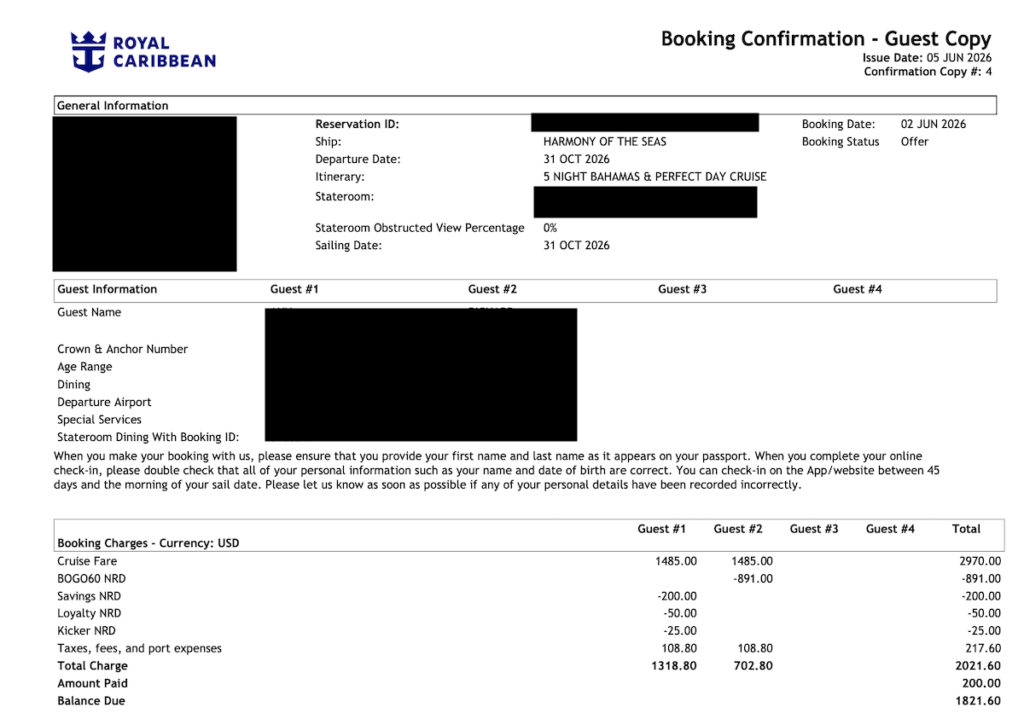
My June 2026 Royal Caribbean invoice is a good example. I booked a 5-night Bahamas cruise on Harmony of the Seas for two people. The base price, including taxes, fees, and port expenses, was $2,021.60. Gratuities added another $185. The drink package was $71.99 per person per day, or $84.95 with the 18% gratuity included. The total for two came to $3,056.10.
Of that amount, only $1,804.00 was the portion of the fare eligible for a discount. Even if that entire amount had been waived, I still would have paid $1,252.10 for the cruise.
How Much Does a Percent-Off Cruise Deal Really Save?
A percent-off promotion applies only to the portion of the fare eligible for a discount. In my September 2026 test booking, that was about a third of the total price. A “50% off” promotion translated to roughly 18% off my actual cost once taxes, fees, and gratuities were included.
The discount is calculated using a reference price, which Norwegian’s terms allow to be a price that wasn’t offered during the previous 90 days. Different promotions can also result in nearly identical totals, so compare two or three offers for the same cabin and sailing.
Is Onboard Credit Worth the Same as a Discount?
It depends on how much you’d spend onboard. A $200 onboard credit is worth the same as a $200 discount if you would have spent that money on eligible purchases anyway. Otherwise, you could end up with credit you don’t need. Onboard credit can also be non-transferable, have no cash value, and expire if you don’t use it.
The same principle applies to dining credits, drink packages, Wi-Fi, and excursion credits. Check who receives the benefit, whether it’s per person, per cabin, or Guest 1 only. Also check what you can use it for and whether there are spending limits for each guest or port.
Celebrity provides a good example for solo travelers. A single guest receives double the onboard credit, but the drink and Wi-Fi packages remain per person. Rules for cashing out or transferring credits also depend on the cruise line and whether the credit came from the cruise line or a travel agency.
Norwegian’s Free at Sea: What It Includes and Who It Covers
Norwegian’s Free at Sea benefits have different eligibility rules depending on the perk. Norwegian splits them into four categories:
| Perk | Who gets it |
|---|---|
| Beverage package | Guests 1 to 8. Guests 1 and 2 must be 21 or older for the full package, or they get the Soda Package. Guests 3 to 8 who are under 21 get neither. |
| Specialty dining | Guests 1 to 8 age 2 and up. Children 12 and under order from the kids’ menu. Guests 13 and up order from the standard menu. |
| Wi-Fi | Every guest, 150 minutes each, one login per guest on one device at a time, with no streaming. |
| Shore excursion credit | Guest 1 only, up to $50 per port. Unused value is forfeited. |
These terms apply to bookings made from November 5, 2025. If you booked under the earlier More at Sea program, your original terms still apply. Each eligible guest also pays a per-person service charge for the packages, separate from the daily onboard service charge.
The beverage package also has different rules depending on which private island you’re visiting. You can use it at Great Stirrup Cay, but it doesn’t cover bars, restaurants, or venues at Harvest Caye. My guides to Great Stirrup Cay and Harvest Caye cover the islands themselves.
Free at Sea Plus is an upgrade that costs $49.99 per adult per day and is available only with a Free at Sea booking. If you booked with a gratuities-included promotion, the price is $15 less per person per day. When Norwegian advertises a “total value” for the package, compare that figure with what you’d actually use.
Other Bundles Work the Same Way
Celebrity’s All Included bundle combines the cruise fare with a Classic Drink Package and Basic Wi-Fi for everyone in the stateroom. Everyone in the cabin must book the same rate. Beverage gratuities are included with the drink package, while other onboard gratuities are charged separately.
Free third- or fourth-guest promotions typically cover the cruise fare. You’ll still pay taxes, fees, and any optional purchases. Promotions are often limited to a certain number of cabins, can be withdrawn without notice, and have different rules about combining offers. Before booking, check exactly what’s included and how many guests receive each benefit.
Paying for Your Cruise Safely
Payment scams can happen around final payment time or afterward, when travelers are expecting to send money.
Pay by credit card. A credit card usually gives you a way to dispute a charge that you wouldn’t have with a wire or debit transfer. If someone pressures you to use a payment method without that protection, consider it a warning sign.
Federal rules also protect payments made to cruise lines. Under the Federal Maritime Commission’s rule at 46 CFR Part 540, cruise lines embarking passengers at U.S. ports on ships with 50 or more berths must demonstrate they can refund passengers if a voyage doesn’t take place. They can provide insurance, an escrow account, a bond, or another guarantee covering at least 110% of fares already collected for voyages that haven’t sailed, up to a cap.
If your cruise is canceled or delayed by three or more days and you decide against sailing, request a refund from the cruise line first. If the cruise line denies your claim or doesn’t resolve it within 180 days, you can file a claim against that financial coverage.
Watch for Fake Payment Pages in Search Results
While researching this series, I found two live examples. One was a compromised, official-looking PDF hosted on an unrelated website. The other was a look-alike page with cruise line branding but a web address that didn’t match. Both repeated the same phone number throughout the page. I suspect the repetition was intended to get past spam filters, although that’s my inference.
I won’t name the files or websites because they change. Instead, check that the web address belongs to the cruise line and that the phone number matches your booking confirmation.
Insider Tip: Spoofed web addresses can replace letters with look-alike characters, such as a zero instead of the letter O or a lowercase l instead of a capital I. Type the address yourself or use a bookmark saved from the cruise line’s real website. Avoid clicking through from search ads or text messages.
The same caution applies onboard. My guide to protecting your money and staying connected on a cruise covers scams targeting travelers while they’re away from home.
Should You Pay Off Your Cruise Early?
Most cruise lines let you pay off your cruise early without penalty. I’d only do it for a specific reason, such as spreading the cost across your monthly budget. If you pay early and later cancel a refundable booking, you could spend weeks waiting for a refund of money you didn’t need to pay yet.
Otherwise, I’d leave the money in your account until final payment is due and set a calendar reminder a week beforehand. Your cabin and fare stay the same whether you pay early or wait until the deadline.

Before paying a cruise deposit, confirm the fare rules, final payment date, and cancellation penalty schedule on the cruise line’s official page for your sailing.
Next Steps
Protecting the money you’ve committed starts with travel insurance for a cruise, and the guide on how to prepare for a cruise covers the planning that follows the booking.
Travel safe
— Rick Hayes, Travel Safety Authority
Conditions change fast. Verify current advisories at travel.state.gov before your trip. This article is general information based on my experience, not professional security advice. See the full Disclaimer.