How to Choose a Cruise Itinerary: Comparing the Major Cruise Regions
Two cruises to the same region can be very different trips. One might spend most of the week in port, while another has three days at sea. One might leave from a city you can drive to, while the other requires a flight. When you choose a cruise itinerary, look beyond the destination. Compare the ports, time ashore, sea days, and departure city before deciding which sailing works best for you.
Booking a cruise comes down to four decisions: which cruise line, which region or itinerary, when to sail, and which cabin. This is the companion guide to the region and itinerary decision, and the overview of how to book a cruise covers all four.
Companion guides cover how to choose a cruise line, the best time to go on a cruise, and cruise cabin types explained. Paying for the trip has its own guide, covering cruise deposits, final payment, and booking perks.
Current as of November 2026. Port rules, fees, and schedules change, so confirm the details on the cruise line’s own itinerary page before you book.
How Do You Choose a Cruise Destination?
Decide what you want from the trip: warm-weather beaches, scenery and wildlife, or history and culture. Narrow the options by how far you’ll travel to the departure port, how long you can be away, and what time of year you can sail.
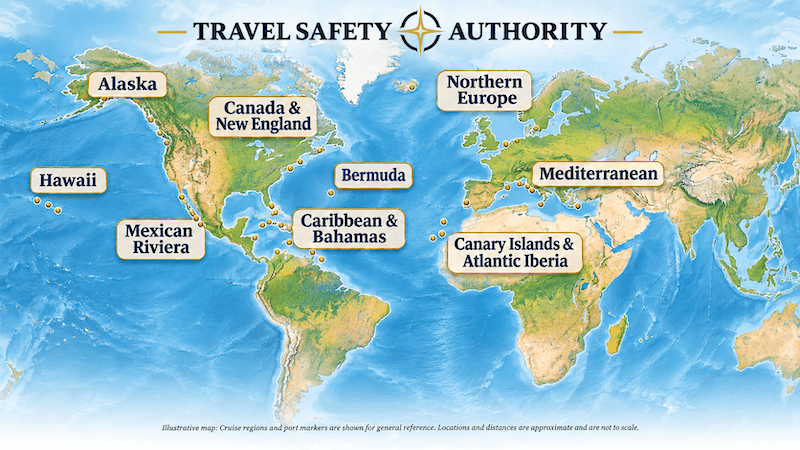
Beaches are in the Caribbean and Bahamas, Hawaii, and the Mediterranean. Alaska and Northern Europe cover glaciers, fjords, and dramatic coastline. History, architecture, and walkable old towns are in the Mediterranean and the rest of Europe. The categories overlap, and a Mediterranean sailing can have a beach day and an ancient ruin in the same week.
Some people pick a region for the wildlife. Alaska’s peak wildlife viewing runs June through August. In Hawaii, December through March is peak whale-watching season.
A departure port within driving distance often saves a flight and a hotel night. Trip length narrows the list too. Caribbean sailings run from four nights to more than ten, Norwegian’s inter-island Hawaii cruise is a fixed seven nights, and Princess’s Hawaii cruises from the mainland run much longer. Each region below includes its operating window in one line, and the guide to the best time to go on a cruise has the month-by-month detail.
The Major Cruise Regions Compared
You could spend the morning snorkeling in the Caribbean, watch a glacier break apart in Alaska, or walk through the narrow streets of a centuries-old Mediterranean town.
| Region | The Draw | Ports Include | Best Time to Sail | Choose It If |
|---|---|---|---|---|
| Caribbean and Bahamas | Beaches, warm water, island ports, private destinations | Eastern: Virgin Islands, St. Maarten. Western: Mexico, Belize, Jamaica, Grand Cayman. Southern: Aruba, Bonaire, Curaçao | December through April for beach weather. September and October are cheaper, with storm risk | You want beach time and the most choice of trip lengths and departure ports, from Florida to Puerto Rico |
| Alaska | Glaciers, mountains, wildlife | Juneau, Ketchikan, Skagway, and Seward | June and early July for warm, dry weather and wildlife. May and September are cheaper and quieter, with more rain | Scenery is the point of the trip, and a balcony cabin is worth paying for |
| Mediterranean | History, culture, walkable old towns | Ports in Spain, Italy, Greece, and Croatia | May, early June, and September for mild weather and manageable crowds. July and August bring heat of 85 to 95°F | You want a new historic town on most days |
| Northern Europe | Fjords, Iceland, the Baltic, the British Isles, Amsterdam | Norwegian fjords, Iceland, and Amsterdam. St. Petersburg is no longer a normal stop | June for the longest daylight. September is calmer and cheaper. July and August are the peak | You want dramatic scenery in cool summer weather |
| Canary Islands and Atlantic Iberia | Warm, sunny weather when most of Europe is out of season | Tenerife, Las Palmas, Lanzarote, La Palma, La Gomera, and Madeira | Any month. Late fall is when the Mediterranean and Northern Europe seasons wind down | You want warm weather in the off-season |
| Bermuda | A round trip from the Northeast | Bermuda, from New York, New Jersey, Boston, and Philadelphia | Late March to early November, with May and June the busiest. August through October is storm season | You want to sail from near home without flying |
| Canada and New England | Historic cities, lighthouses, and coastal scenery | Boston, Portland, Québec City, Halifax, and Charlottetown | Late September to mid-October for fall foliage. Summer for whales and long days. Bar Harbor limits are enforced in July and August | You want fall color or a Northeast departure, and you’ll check each port’s rules |
| Hawaii | Island scenery | Four islands in seven days on Pride of America, with overnights in Maui and Kauaʻi. Mainland sailings add a foreign port such as Victoria | April through October for the least rain. December through March for whale watching | A week-long trip points to Pride of America. Mainland cruises run much longer |
| Mexican Riviera | A short warm-weather trip from the West Coast | Puerto Vallarta, Cabo San Lucas, and Mazatlán | Avoid late June to early October, when most eastern Pacific storms form | You live on the West Coast and want a week or so of sun without flying |
Caribbean and Bahamas
The Caribbean is the one region here that sails all year, so what matters most is which islands a sailing reaches and where it leaves from.
How Do Eastern, Western, and Southern Caribbean Cruises Differ?
Cruise lines use the labels loosely, but the pattern holds. Western sailings visit Mexico, Belize, Jamaica, and Grand Cayman, often from Florida and Texas. Eastern sailings visit the Virgin Islands, St. Maarten, and nearby islands. Southern sailings reach Aruba, Bonaire, and Curaçao.
The Eastern and Western labels were created by cruise lines to make it easier for cruisers to know where to start their search. Carnival’s own port lists show how loose they are: St. Thomas and St. Maarten appear under both Eastern and Southern.
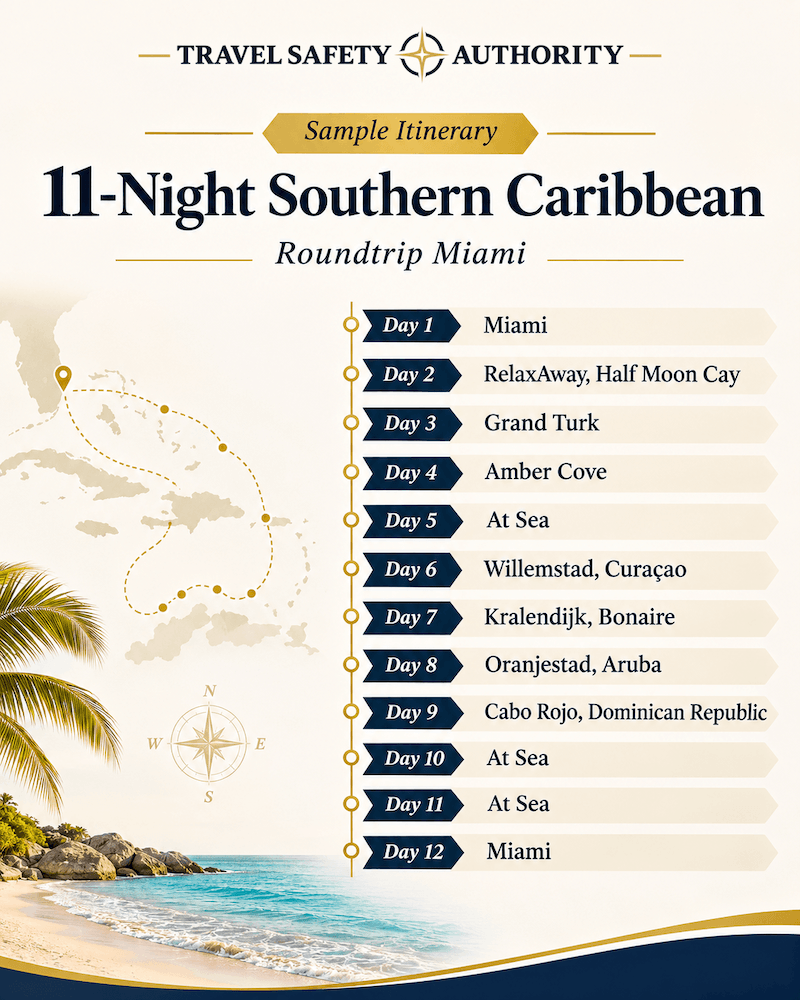
Trip length depends on the cruise line. Most cruise lines run Western sailings from four nights up to seven nights and longer, and many Eastern voyages run 10 nights or more. Royal Caribbean’s Southern examples are an eight-night sailing from Fort Lauderdale and a nine-night sailing from Miami. Carnival lists Eastern sailings from ports as far north as New York and Southern sailings from San Juan, Barbados, and Florida. None of these cruise lines publishes a sea-day count by region, so count the sea days on each sailing’s day-by-day schedule.
Private Destinations in the Caribbean and Bahamas
Many Caribbean and Bahamas itineraries include a cruise line’s private destination, and most are in the Bahamas. Royal Caribbean’s Perfect Day CocoCay, Norwegian’s Great Stirrup Cay, Disney’s Castaway Cay, and MSC’s Ocean Cay are all there. Carnival’s Celebration Key is on Grand Bahama, and Virgin Voyages has its beach club at Bimini. Norwegian’s Harvest Caye, in southern Belize, is the exception.
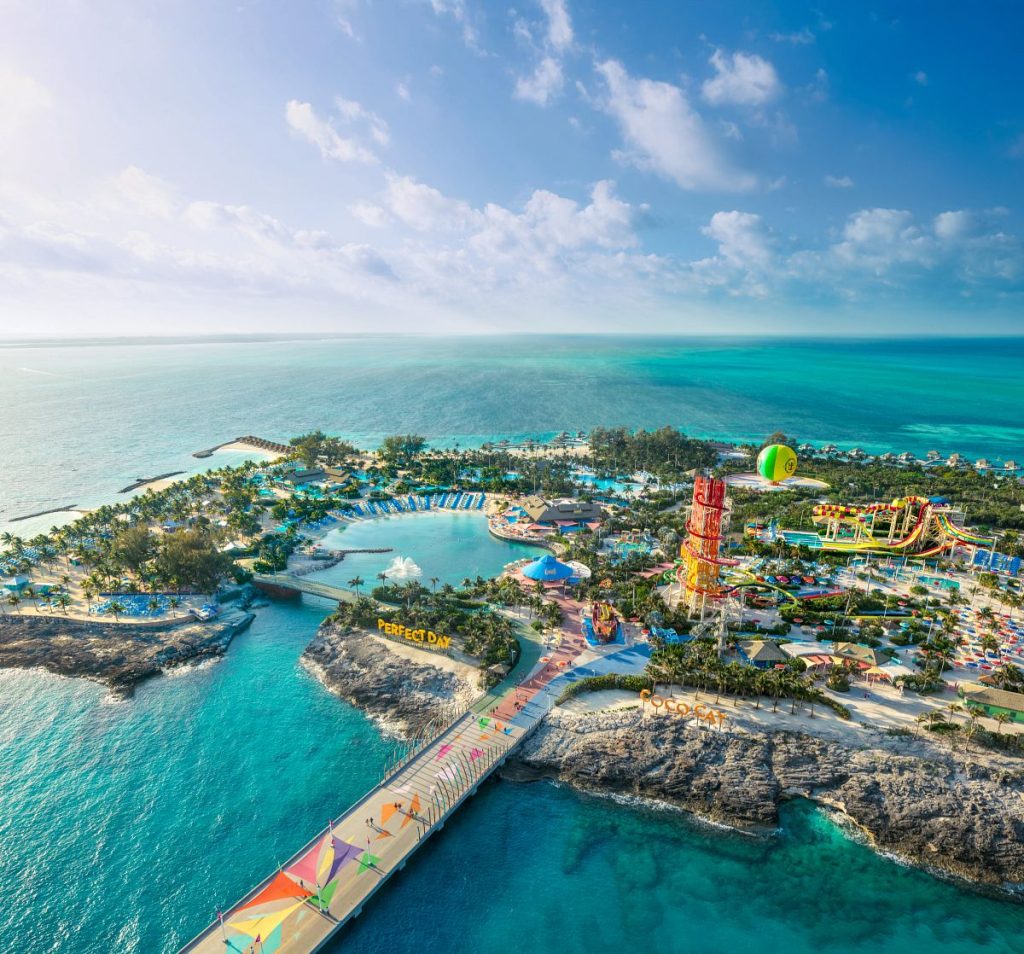
Many Eastern and Western itineraries from Florida include one. Royal Caribbean offers its private destination on Western Caribbean sailings as well as Eastern ones. Norwegian’s Eastern Caribbean cruises include Great Stirrup Cay. Some of its Western Caribbean cruises include it too, while others stop at Harvest Caye instead.
Southern Caribbean sailings are different. Norwegian and Virgin Voyages often run them from San Juan, Puerto Rico, and those sailings usually skip Great Stirrup Cay and Bimini. Virgin’s 7-night Southern Caribbean sailing visits Aruba, Curaçao, Martinique, and St. Kitts. Norwegian Prima’s 7-night sailings from San Juan go to Bonaire, St. Maarten, St. Thomas, and Tortola, or to Dominica and Barbados. None includes a private destination, so check the port list before you count on one.
The Best Time for a Caribbean Cruise
If you want a beach day with good weather and clear water, December through April is the safest bet. That stretch has the best beach weather and snorkeling conditions, while summer and fall may bring itinerary changes or rougher seas.
We typically sail from late November to early December. We’ve done Norwegian Eastern Caribbean cruises, Royal Caribbean Southern Caribbean cruises, and Bahamas cruises in November, December, and January, and each time the crowds were smaller and the weather was great.
Summer and fall are cheaper because of hurricane season. Atlantic hurricane season runs June 1 to November 30, and the worst of it falls between mid-August and mid-October. A storm can force a ship to skip a port or swap it for another, so a sailing in those weeks may not visit every island on the schedule. The lowest prices tend to show up in September or October, for travelers willing to risk some rain.
Port conditions vary within the region. I’ve written guides on Nassau, Taino Bay, and St. Thomas.
Alaska
Alaska cruises are about glaciers, mountains, and wildlife, and the season is short. Ships sail from late April to early October.
Book June through August for the best wildlife and the warmest temperatures. The long days give you more daylight to watch for glaciers and whales, but these are also the busiest months, and cabins sell out fast. May and September cost less and draw thinner crowds. The trade-off is more rain and chilly mornings.
Peak season and the best weather don’t line up. In Juneau, the best odds of warm, dry weather run from April through early July. That means June and early July give you the strongest overlap of good weather and peak wildlife, while a mid-August sailing falls after that stretch.
Book as early as possible. A year in advance or longer lets you pick the cabins with the best view. People pick Alaska for the scenery, so a balcony cabin is easier to justify here than on a port-heavy itinerary. The cruise cabin types guide covers what each cabin type gives you.
Mediterranean
The Mediterranean is a sightseeing region: history, culture, and walkable old towns. Most Mediterranean cruises sail from April through October, but several cruise lines also sell off-season sailings.
Aim for May, early June, or September. The weather is mild enough to spend a full day walking old towns and ruins, and the crowds are more manageable than in summer.
Summer costs the most and draws the biggest crowds, and the heat is the main reason to think twice. Summer highs reach 85 to 95°F across Spain, Italy, Greece, and Croatia, which wears on a port-heavy day on foot. Some shops in Italy close in August while locals take their own vacations, and the sea can be too cold for swimming until June. By October and November the season is winding down, with cooler, wetter days.
Northern Europe
Northern Europe covers Iceland, the Norwegian fjords, the Baltic, the British Isles, and Amsterdam. Most sailings run from May through September, and some continue into October.
Sail in May if you want fewer crowds and lower fares. June and July have the longest days, and north of the Arctic Circle the sun doesn’t set at all. July and August are the busiest, with ships that sell out sooner and crowded excursions such as the Flåm railway in Norway. September is calmer and cheaper, with early fall color, and the northern lights become more likely late in the month. By October it is cold.
Can You Still Cruise to St. Petersburg?
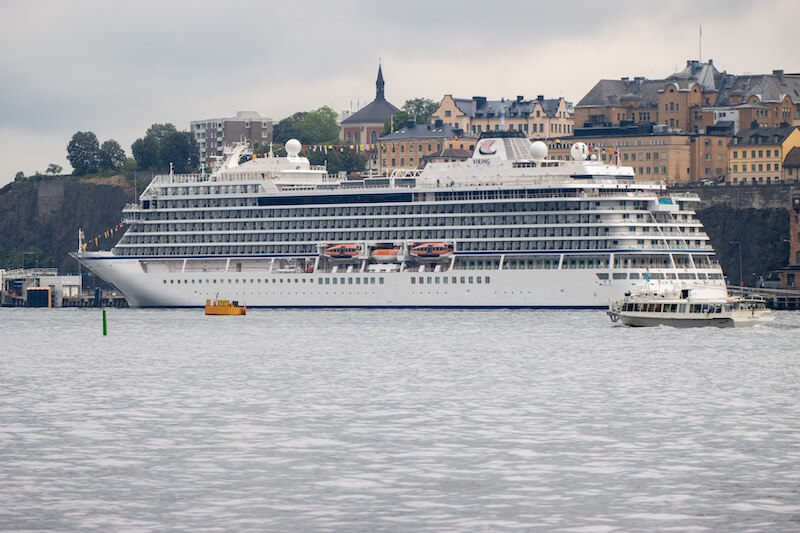
St. Petersburg is no longer a normal port of call on Baltic cruises. The State Department rates Russia Level 4, Do Not Travel, in an advisory issued December 29, 2025. If an older guide or a listing still shows the port, treat it as out of date and check the cruise line’s current itinerary.
Baltic cruises used to include a stop in St. Petersburg, and the Baltic has fewer sailings without it. CLIA’s 2024 European report ties this the Baltic’s decline to the port’s absence from itineraries.
What Do You See on an Iceland Cruise?
Iceland is the stop for scenery you won’t find anywhere else on a cruise. It has waterfalls, lava fields, glaciers, and fjords, and each port is a different part of the island. From Reykjavik, the Golden Circle day trip reaches Gullfoss waterfall, and the Blue Lagoon is the best-known geothermal pool.
Akureyri in the north has Godafoss waterfall, a mud bath at Lake Myvatn, and whale watching for humpback, minke, and orca whales. Isafjordur is the gateway to the Westfjords, with the 300-foot-plus Dynjandi waterfall and fjord kayaking.
June and July are the best months, with about 21 hours of daylight, little rain, and temperatures of 49 to 59°F. That is why excursion days feel long. The northern lights are possible from late August through October, but September and October are the wettest months.
Is Amsterdam Worth a Port Day?
Yes, if you like a city you can see on foot. The city center is compact and easy to walk, and the main draws are close together: the canals, the Rijksmuseum, the Van Gogh Museum, and the Anne Frank House. Holland America offers canal cruises and a hop-on, hop-off tour for people who would rather ride than walk.
You won’t fit every museum into one port day, so pick one or two. The Anne Frank House sells out, and the Rijksmuseum uses timed entry, so book ahead.
The Canary Islands and Atlantic Spain and Portugal
The Canaries are the warm-weather option when most of Europe is out of season. The islands are warm and sunny year-round, with average temperatures around 23°C (73°F) in summer and 19°C (66°F) in winter, so you can find a sailing in any month. By late fall the Mediterranean and Northern Europe seasons are winding down, and the Canaries keep going.
They are sold two ways. The first is island hopping on sailings that start in the islands. MSC lists seven- and eight-night itineraries from Santa Cruz de Tenerife and Las Palmas, visiting ports such as Lanzarote, La Palma, La Gomera, and Funchal on Madeira.
The second is a longer voyage that combines the Canaries with Madeira, mainland Iberia, or Morocco. Royal Caribbean’s 10-night itinerary from Lisbon visits Madeira, Tenerife, Gran Canaria, Casablanca, and Tangier, then ends in Barcelona. That makes it a one-way trip, so your flight home leaves from a different city. Cunard says its Canary voyages usually visit three or four islands, with Madeira often visited on the way.
Bermuda
Bermuda cruises are round trips from the Northeast, so you can start close to home if you live near New York, New Jersey, Boston, or Philadelphia. The official 2026 cruise ship schedule lists six ships that sail to Bermuda on a regular basis: Norwegian Aqua from New York, Norwegian Jewel from Philadelphia, Norwegian Breakaway from Boston, Royal Caribbean’s Vision of the Seas from Boston, Royal Caribbean’s Independence of the Seas from New Jersey, and Celebrity Silhouette from New Jersey.
Those ships sail from late March to early November, and May and June are the busiest months for them. Outside that window, nearly all visits are by occasional ships, so winter is not a normal cruise season in Bermuda. Use the schedule, not hotel “low season” labels, to judge when cruise service runs.
Bermuda also sits inside the Atlantic hurricane basin, so August through October sailings fall in the stretch when storms are most likely.
Canada and New England
Canada and New England cruises pair historic cities with coastal scenery: Boston’s Freedom Trail, Portland Head Light in Maine, Québec City’s old center, and Halifax with day trips to Peggy’s Cove. Celebrity’s sailings are 10 or 11 nights, round trip from Boston. Halifax’s 2026 season opened April 7 with the arrival of Viking Polaris.
Fall is the draw. Peak foliage runs from late September to mid-October, moving north to south, and the lines at historic sites are shorter, though fall sailings fill up early. Summer has the longest days and whale watching in the Bay of Fundy and the Saguenay Fjord, with Montréal and Québec City at their liveliest. May and June are quieter and cooler, with icebergs off Newfoundland and puffins at Witless Bay.
Bar Harbor, Maine, shows how a port’s rules can change what you can book. Voters approved a 1,000-passenger daily limit, and a federal judge ruled in May 2026 that the town can enforce it only in July and August. So whether a large ship can visit may depend on the month. The town also said it would not accept new advance cruise ship reservations until it adopts rules that match the court rulings and the litigation is resolved. The dispute is still moving, so verify the status for your sailing date.
Hawaii
Hawaii cruises come in two forms. One is a seven-night inter-island loop on a U.S.-flagged ship, one of the few that can hop between Hawaiian ports on a single cruise. The other is a longer round trip from the U.S. mainland.
Why Do Hawaii Cruises From California Stop in a Foreign Port?
A federal law, the Passenger Vessel Services Act, bars foreign-flagged ships from carrying passengers between two U.S. ports. Norwegian’s U.S.-flagged Pride of America sails inter-island from Honolulu. Longer Hawaii cruises from the mainland, such as Princess’s from California, include a stop in a foreign port.
The statute says a vessel may not transport passengers between U.S. ports “either directly or via a foreign port” unless it is U.S.-owned and holds a coastwise endorsement from the U.S. Coast Guard, which is the authorization to operate between U.S. ports. Customs and Border Protection enforces it, and its guide to the act lists a penalty of $300 for each passenger.
Norwegian says Pride of America is the only U.S.-flagged cruise ship in Hawaiʻi and the only ship cruising year-round from Honolulu. It leaves every Saturday and visits four islands in seven days, with overnights in Maui and Kauaʻi, so you see several islands without flying between them. The mainland cruises are much longer, so for a week-long vacation, book the inter-island ship.
Hawaii’s dry season and whale season fall in different months. April through October is the dry season, with the least rainfall, and December through March is the peak for whale watching.
The Mexican Riviera
Princess’s Mexican Riviera cruises are the West Coast’s short warm-weather option. They sail seven or 10 days from Los Angeles or San Francisco and visit Puerto Vallarta, Cabo San Lucas, and Mazatlán. Departure ports vary by cruise line and sailing, so check the itinerary.
The weather concern here is eastern Pacific hurricane season, a separate basin from the Atlantic. The National Hurricane Center puts the season at May 15 to November 30, and most storms form between late June and early October. Sailings in those months carry the most storm risk.
Beyond the Mainstream Regions
Antarctica is an expedition trip, not a mainstream cruise. The German Environment Agency says the tourist season runs roughly November to March, and that ships carrying more than 500 passengers may not land passengers in the Antarctic Treaty area. That means landings are limited to smaller ships.
Australia and the South Pacific have their storm season at a different time of year: Australia’s Bureau of Meteorology says the tropical cyclone season runs from November to April. Check the season for the specific sailing.
How Do You Compare Two Cruise Itineraries in the Same Region?
Compare the ports and how long the ship stays in each, late or overnight stays, the number of sea days, the departure port, and whether it’s a round trip. Two sailings in the same region can be very different trips.
- Check the hours in each port. A full day and a short stop count differently, even when both list the same port. Norwegian requires guests back onboard one hour before the ship’s scheduled departure, so time ashore is shorter than the schedule suggests.
- Find out which ports are tender ports. At a tender port the ship anchors offshore and small boats carry passengers to land, a ride that runs roughly 5 to 20 minutes and can mean waiting your turn.
- Look for late and overnight stays. They give you time ashore after other ships leave. Azamara, for one, counts 10 or more hours in port as an “Extended Destination Day” and builds late nights and overnights into its itineraries.
- Count the sea days. Some travelers want several, and others want a packed port schedule.
- Weigh the departure port. A close port saves travel, and a farther one may come with the stronger itinerary.
- Confirm whether it’s a round trip. A one-way voyage ends in a different city, as the Lisbon-to-Barcelona sailing above does.
- Read the cruise line’s terms on port changes. Summer and fall in the Caribbean may bring itinerary changes or rougher seas.
Insider Tip: I start with the kind of trip I want. For a relaxed beach trip, I scan the larger ports in the destination and list the best beaches within a short drive of each. Then I compare that list against each itinerary to see which one reaches the most of them. You can do the same for any type of trip.
How to Choose a Cruise Itinerary When Two Sailings Look Similar
Say two Western Caribbean sailings cost about the same. One leaves from a port two hours from home, has one sea day, and stays in each port until the afternoon. The other needs a flight and a hotel night, has no sea days, and stays in port until late evening. The one that fits what you want will be the better choice. The first fits a traveler who wants an easy start and a slow pace, and the second fits one who wants the most time ashore and will pay for the travel.
Where Smaller Ships Change the Itinerary
A smaller ship can sail to harbors that bigger ships skip. Windstar, which operates yachts carrying 148 to 342 guests, lists Hvar and late-night stays in Málaga, Cannes, Monte Carlo, Dubrovnik, and Portofino among its Mediterranean examples.
Researching the Ports on Your Itinerary
Port safety conditions differ by destination, and they can differ between two ports on the same itinerary. Beyond the advisory, check whether each stop is a dock or a tender port and how long the ship stays. Check the U.S. State Department’s travel advisory for each country the ship visits. An advisory doesn’t change an itinerary by itself, because the cruise line makes that decision, but it is a warning worth taking seriously. Russia, for example, is rated Level 4, and St. Petersburg is no longer a normal stop on Baltic cruises. The Israel-Palestine conflict led several cruise lines to drop their Israel calls, and the war with Iran removed Middle East sailings from some lines’ plans.
For the ports themselves, my cruise port safety tips cover what to watch for ashore, while the shore excursion safety checklist covers what to check before booking time off the ship. If the itinerary includes foreign ports, the guide to documents needed for a cruise covers what paperwork to have ready.
Choosing a cruise itinerary depends on what you want from the trip, a departure port you can reach, and the day-by-day details that separate two sailings with the same name.
Next Steps
If your itinerary includes a private destination, the Perfect Day at CocoCay guide and the Great Stirrup Cay guide show what to expect there.
Travel safe.
— Rick Hayes, Travel Safety Authority
Conditions change fast. Verify current advisories at travel.state.gov before your trip. This article is general information based on my experience, not professional security advice. See the full Disclaimer.